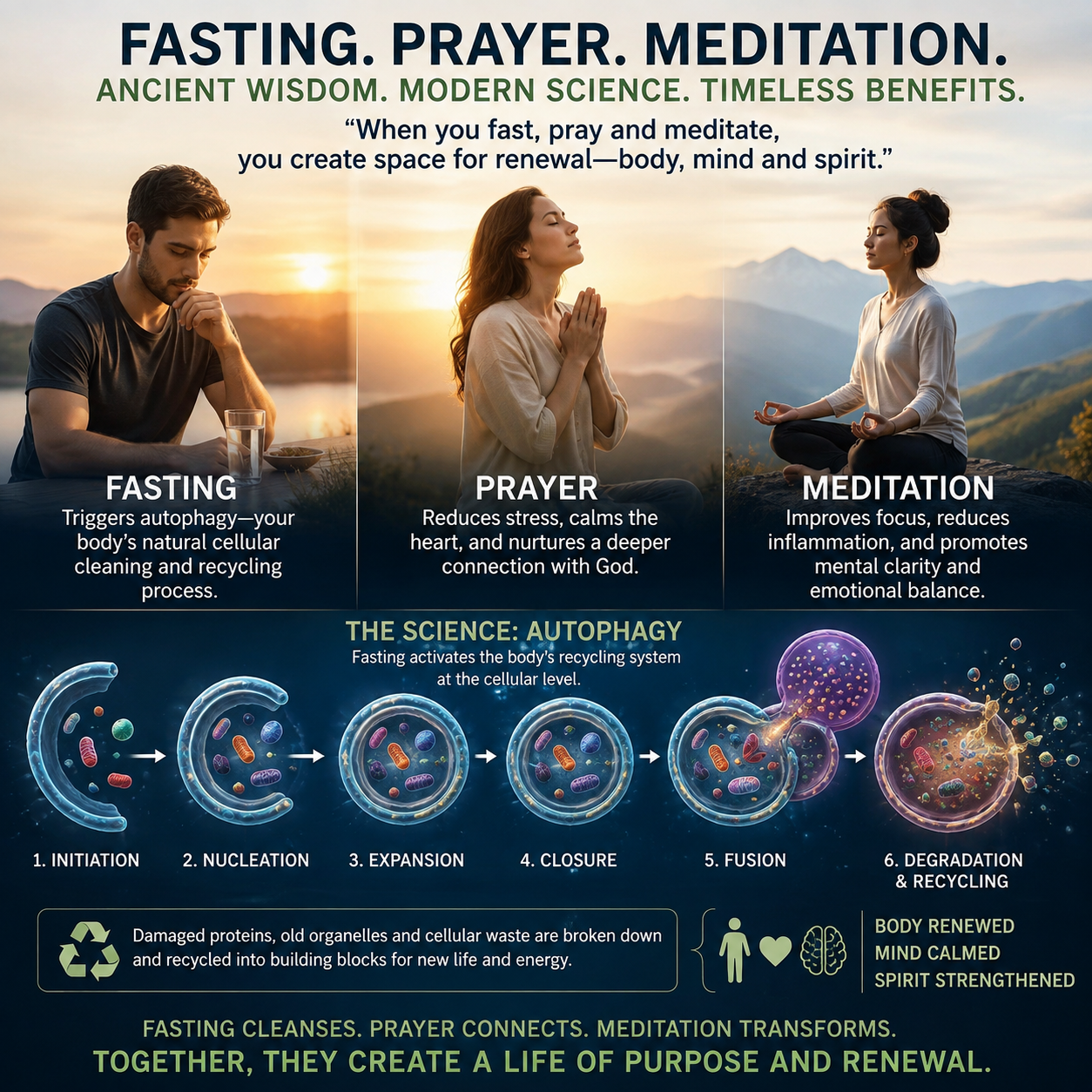
For thousands of years, spiritual traditions around the world have encouraged three simple practices: fasting, prayer, and meditation.
Long before microscopes, molecular biology, or neuroscience, people believed these practices purified the body, calmed the mind, and opened the heart to the Divine.
Today, modern science is beginning to uncover fascinating biological changes that occur during these practices. While science cannot measure spiritual transformation, it can measure many of the physical processes that accompany these ancient disciplines.
Perhaps ancient wisdom understood something that science is only beginning to explain.
Fasting: The Body’s Built-In Renewal System
Every cell in your body contains an extraordinary recycling program called autophagy, meaning “self-eating.”
Although the name sounds alarming, autophagy is one of the body’s most remarkable repair systems.
As we live our lives, cells accumulate damaged proteins, worn-out mitochondria, invading microbes, and other cellular debris. Left unchecked, this buildup contributes to aging and disease.
When nutrients become scarce during fasting, the body shifts priorities.
Instead of focusing on growth, it begins focusing on repair.
Scientists have discovered that fasting activates AMPK, suppresses mTOR, and initiates a carefully orchestrated sequence that forms structures called autophagosomes. These tiny cellular recycling centers surround damaged material, transport it to lysosomes, break it down into its basic building blocks, and recycle those components to build healthier cells.
The process unfolds through six remarkable stages:
- Initiation
- Phagophore formation
- Expansion
- Autophagosome completion
- Fusion with the lysosome
- Degradation and recycling
The result is a cleaner, more efficient cellular environment.
In many ways, fasting allows the body to perform its own internal housekeeping.
Human studies suggest fasting can promote metabolic flexibility, improve insulin sensitivity in many individuals, and stimulate cellular repair pathways. However, researchers are still studying exactly how much autophagy occurs in different human tissues and what fasting duration produces the greatest benefit.
Prayer: Nourishing the Spirit
If fasting primarily changes the body’s metabolism, prayer transforms our attention.
Jesus often withdrew from the crowds to pray.
He encouraged His followers to pray sincerely rather than for public recognition.
Prayer shifts our focus away from constant external demands and toward something greater than ourselves.
Scientific research has shown that contemplative prayer may:
- Reduce stress hormones
- Lower blood pressure in many people
- Improve emotional resilience
- Increase feelings of gratitude and compassion
- Activate the parasympathetic nervous system
Prayer may not simply change our circumstances.
It often changes us.
Meditation: Quieting the Mind
Meditation has also become one of the most extensively studied mind-body practices.
Brain imaging studies suggest regular meditation can influence areas involved in attention, emotional regulation, and self-awareness.
Researchers have observed associations with:
- Reduced perceived stress
- Improved attention
- Better emotional regulation
- Increased heart rate variability in some people
- Improved sleep quality for many practitioners
Meditation does not necessarily empty the mind.
Instead, it teaches us to observe thoughts without becoming controlled by them.
In stillness, clarity often emerges.
Three Practices—One Direction
Seen together, fasting, prayer, and meditation appear to work on different dimensions of our being.
Fasting encourages the body to repair and recycle.
Prayer opens the heart toward the Divine.
Meditation calms the mind and develops awareness.
Each practice complements the others.
The body becomes quieter.
The mind becomes clearer.
The heart becomes more receptive.
Ancient Wisdom and Modern Discovery
Jesus frequently spoke about fasting and prayer.
Many spiritual traditions likewise recognized periods of silence, self-denial, and contemplation as pathways to transformation.
Modern science is now revealing measurable biological changes that accompany many of these practices.
Science does not prove spiritual truths.
Nor do spiritual teachings replace scientific investigation.
Rather, they explore different dimensions of human experience.
One investigates mechanisms.
The other explores meaning.
When practiced wisely and appropriately, fasting, prayer, and meditation invite us into a rhythm that benefits body, mind, and spirit.
Perhaps the greatest lesson is this:
Sometimes growth does not come from adding more.
Sometimes it comes from becoming still, letting go, clearing away what no longer serves us, and allowing renewal to begin from within.
Leave a Reply