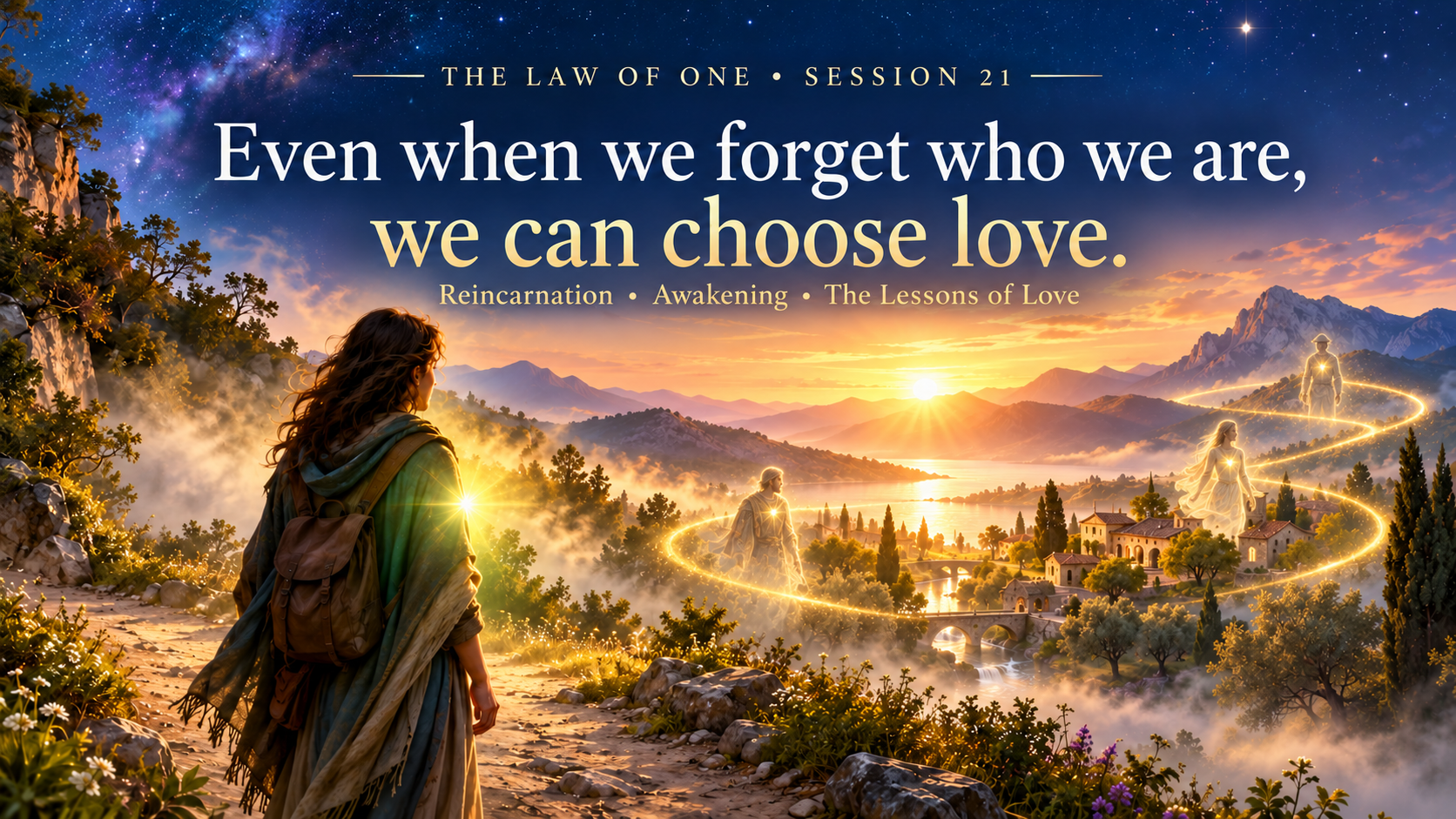
An inspirational reflection on the February 10, 1981 session
What if the deepest measure of a life is the love it learns to express?
Session 21 of the Law of One moves through questions about reincarnation, ancient civilizations, spiritual assistance, and free will. Beneath these subjects runs a simple message: the heart can awaken even when the mind does not understand the larger journey.
The discussion presents Ra’s spiritual account of human origins and development. Its descriptions of Maldek, Lemuria, and planetary cycles belong to the channeled material’s cosmology rather than established history. Read as spiritual teaching, the session invites us to consider how we grow, how we help, and what makes a life meaningful.
Beginning in Forgetfulness
In 21.9, Ra describes third-density incarnation as beginning in a condition of spiritual forgetting. We arrive without conscious access to the wider story of our being. Within this uncertainty, we have room to make choices and discover what matters to us.
According to Ra, an early third-density being is largely concerned with survival and initially relates to others through that concern. Gradually, other needs emerge: companionship, laughter, beauty, and curiosity about the universe. With further experience come the desire to love, to receive love, and to place instinctive behavior within a broader understanding.
This gives ordinary life a spiritual depth. Enjoying a sunset, sharing laughter, or wanting to understand another person can express a consciousness reaching beyond its immediate needs.
We may not remember where we came from. We can still choose kindness where we are.
The Heart Changes the Journey
Ra connects the development of consciousness with changes in the process of reincarnation. In this account, early incarnations follow one another relatively quickly and automatically. As experience increasingly involves the lessons of love, the intervals between lives lengthen to allow more review and healing.
At a certain point, activation of the green-ray energy center—the heart center in Ra’s terminology—marks the end of automatic incarnation. Ra then affirms that an entity can participate in choosing the timing of a subsequent life and its parents (21.9–21.10).
When asked how many entities were making these choices, Ra gives an approximate figure of 54 percent (21.11). This is a claim made in the 1981 session, not a measured present-day statistic.
The spiritual emphasis is growing participation in one’s learning. As love develops, the journey becomes more conscious.
This teaching calls for compassion in its application. It does not give us knowledge of another person’s supposed prebirth choices or grounds for telling someone that they chose their suffering. Our responsibility remains to meet suffering with care.
Healing and the Possibility of Beginning Again
The session revisits the beings associated with Maldek. Ra describes their planetary destruction as leaving them trapped in a collective condition of fear and confusion, followed by assistance, healing, and eventually a decision to undertake further incarnation.
The approximate sequence given in 21.5 places the initial catastrophe 500,000 years before the session, the beginning of release from that condition around 200,000 years before it, and their chosen incarnation on Earth around 46,000 years before it. Ra clarifies that before this incarnation they were undergoing healing in the inner planes (21.6–21.7).
Within this account, recovery takes time. Recognition, healing, and responsibility precede a new beginning.
As a reflection for our own lives, this offers hope: acknowledging harm can become the beginning of repair. We can face what needs to change while allowing ourselves and others the patience that healing requires.
Helping While Respecting Freedom
Free will shapes the session’s account of spiritual assistance. Ra explains that the quarantine surrounding Earth was intensified after genetic assistance given to beings transferred from Mars was judged to have infringed upon their freedom, despite the intention to help (21.8).
Later, when Don asks what happened after the first 25,000-year cycle produced no harvest, Ra describes the Confederation waiting for a call for help or understanding (21.14–21.15). Preserving the conditions for learning remained central.
The opening questions also touch on discernment. Ra describes the claimed communication process and recommends meditation, contemplation, or prayer as preparation for a potential participant. When Don asks whether to withhold information from that person, Ra leaves the decision to his discretion (21.1–21.4).
For the reader, these passages raise a practical question: can we offer help while leaving another person room to choose?
Listening, sharing experience, and making support available can all serve that purpose. Love asks us to care about the person as well as the outcome we hope to see.
A Call Answered with Love
Ra places the first calling discussed in this part of Earth’s story around 46,000 years before the session. It arose among the Maldek entities, whose unconscious awareness of a need to repair the consequences of their actions existed alongside conscious confusion (21.16).
The response described is strikingly simple: the Confederation sent love and light. Ra speaks of beings devoted to offering pure love to those who call, without conveying a conceptual message (21.17).
This suggests a form of service we can recognize in daily life. We do not always have an explanation that eases another person’s pain. Patient presence, a gentle word, or quiet companionship can still be meaningful gifts.
The following discussion explains balancing in terms of opportunity and receptivity, rather than a mechanical requirement that every positive assistance receive an immediately matching negative intervention (21.18–21.20). Ra also distinguishes the calling around 46,000 years ago from Orion contact attempts, placing those attempts at approximately 60,000 and 3,600 years before the session (21.21–21.23).
A Civilization Measured by Its Heart
The historical discussion describes an early period without industrial machinery, though people used wood and stone implements. Ra says the close of the first major cycle brought no abrupt physical transformation of humanity, beyond gradual adaptation to the environment and changes associated with nutrition (21.12–21.13).
Ra then places Lemuria’s origins around 53,000 years before the session and its destruction around 50,000 years before it. Survivors are described as carrying their teachings into other regions. The catastrophe is attributed to natural planetary changes, encouraged by a convergence of energies at the cycle’s end (21.24–21.27).
The session’s most inspiring historical claim comes at its close. Ra describes positive development of the heart center among peoples in the Americas, Africa, Australia, India, and elsewhere, while mentioning some advancement among a group associated with Deneb in China.
In South America, Ra says, a community developed a sufficiently strong orientation toward love to become harvestable at the end of the second major cycle, despite lacking extensive technological development or a powerful social organization (21.28).
Here, harvest means readiness for the next stage of spiritual development within the Law of One framework. The emphasis falls on the quality of consciousness a people cultivate.
That is an encouraging thought for anyone living a quiet life. Caring for family, treating strangers gently, and serving without recognition can carry profound spiritual significance.
Bringing the Teaching into Daily Life
The session ends with attention to Carla’s comfort and physical needs (21.29). After a discussion spanning vast periods of spiritual history, the group returns to the immediate care of the person before them.
We can do the same. We can notice beauty, make room for laughter, offer help respectfully, and give healing time. We can take responsibility for our actions and respond gently when another person struggles.
Session 21 invites us to trust the value of these everyday choices. Even while the larger journey remains mysterious, each moment gives us an opportunity to practice love.
Source: The Law of One, Session 21, February 10, 1981, Home of The Law of One material, L/L Research.
Leave a Reply