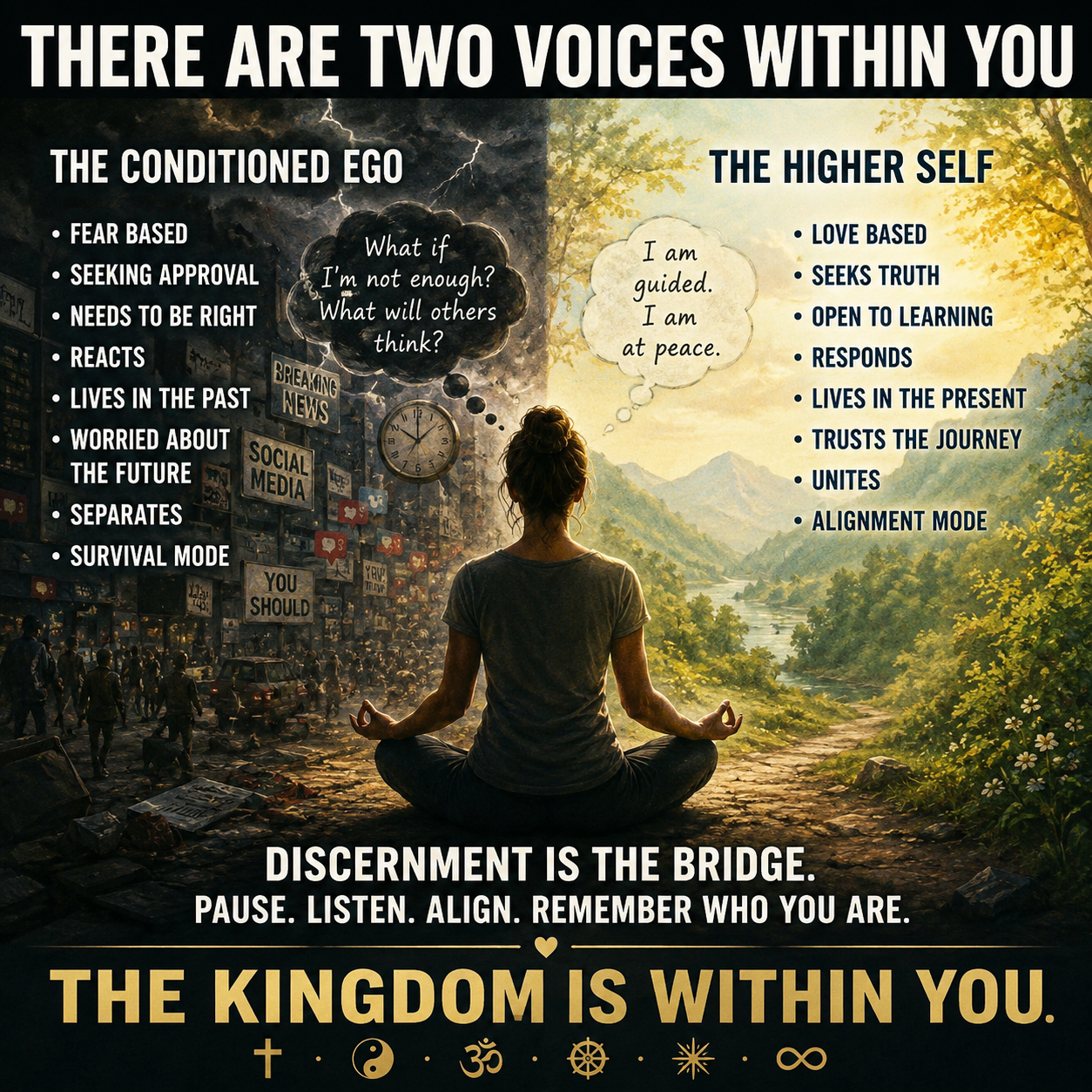
There are close parallels among many spiritual, mystical, and philosophical traditions concerning one of the deepest questions of human life: Who are we beneath our conditioning? Nearly every wisdom tradition, in its own language, points to a distinction between the conditioned ego-self and a deeper level of awareness, intelligence, or divine presence within us.
In The Law of One, this deeper guidance may be understood as the higher self — a more expanded aspect of consciousness that sees beyond immediate desires, fears, reactions, and distortions. In Christianity, Jesus points toward something similar when he says, “The kingdom of God is within you” (Luke 17:21). In Taoism, it resembles alignment with the Tao rather than forcing life through personal will. In Hindu traditions, it echoes the teaching that the Atman, the deepest Self, is not separate from Brahman, the universal reality. Across these traditions, the central idea is remarkably consistent: beneath the conditioned personality is a quieter intelligence that perceives more clearly.
From a psychological viewpoint, all of us are programmed from birth. Much of human behavior is shaped by habitual conditioning. We learn from our parents, schools, culture, religion, politics, social expectations, and especially modern media networks. Too often, we are not taught how to think, but what to think. Our beliefs are absorbed before they are examined.
Our emotional reactions often arise from learned perceptions. Our fears are frequently rooted in social conditioning. Our identity is shaped by family, culture, language, memory, trauma, reward, punishment, and repetition. In many ways, the personality we defend so strongly is partly a construction — a set of habits, stories, and survival patterns we have mistaken for the whole of who we are.
Modern neuroscience would agree that much of human behavior operates automatically. The brain often reacts before conscious awareness fully understands what is happening. We respond from old patterns, familiar fears, and emotional reflexes before the deeper intelligence within us has space to speak.
That is where discernment becomes essential.
Inner guidance is real, but not every inner impulse is wisdom. Some impulses arise from fear, ego, trauma, fantasy, pride, or emotional hunger. Others arise from a deeper place of clarity, balance, and compassion. The spiritual path is not simply learning to “follow your feelings.” It is learning to recognize the difference between conditioned reaction and genuine inner knowing.
Practices such as meditation, contemplative prayer, mindfulness, breath work, dream work, journaling, and simple moments of stillness can help us pause before reacting impulsively. That pause is powerful. It creates space between stimulus and response. In that space, we are no longer merely repeating the past. We can listen more deeply. We can choose more wisely.
That kind of awareness practice can genuinely change a person’s life.
Many mystics describe true inner guidance not as emotional excitement, compulsion, or urgency, but as something much quieter. It often appears as calm clarity, quiet knowing, absence of inner conflict, increased compassion, greater coherence, less fear, and reduced reactivity.
A useful question to ask is:
“Does this guidance lead me toward greater unity, clarity, balance, honesty, compassion, health, and love
Or:
“Does it feed fear, greed , obsession, escapism, dependency or separation?”
This is an important test, because genuine wisdom tends to make a person more balanced, more loving, and more present — not less. True inner guidance does not inflate the ego; it humbles it. It does not separate us from others; it deepens our compassion. It does not create chaos in the name of spirituality; it brings greater harmony between spirit, mind, body, and action.
The idea that infinite intelligence has placed a spark of itself within every person echoes through many traditions: the divine spark in Gnosticism, the indwelling Christ in Christianity, Buddha nature in Buddhism, Atman in Hinduism, the Tao within, the higher self, and The Law of One teaching that all beings are portions of the One Infinite Creator.
The common thread is this: awakening is less about acquiring something new and more about remembering what has always been present beneath the conditioning. It is an uncovering. A return. A realignment with the quiet intelligence that was never absent — only hidden beneath fear, habit, noise, and illusion.
The deeper Self does not need to shout. It waits in stillness. And when we become quiet enough to listen, we begin to remember who we truly are.
Leave a Reply