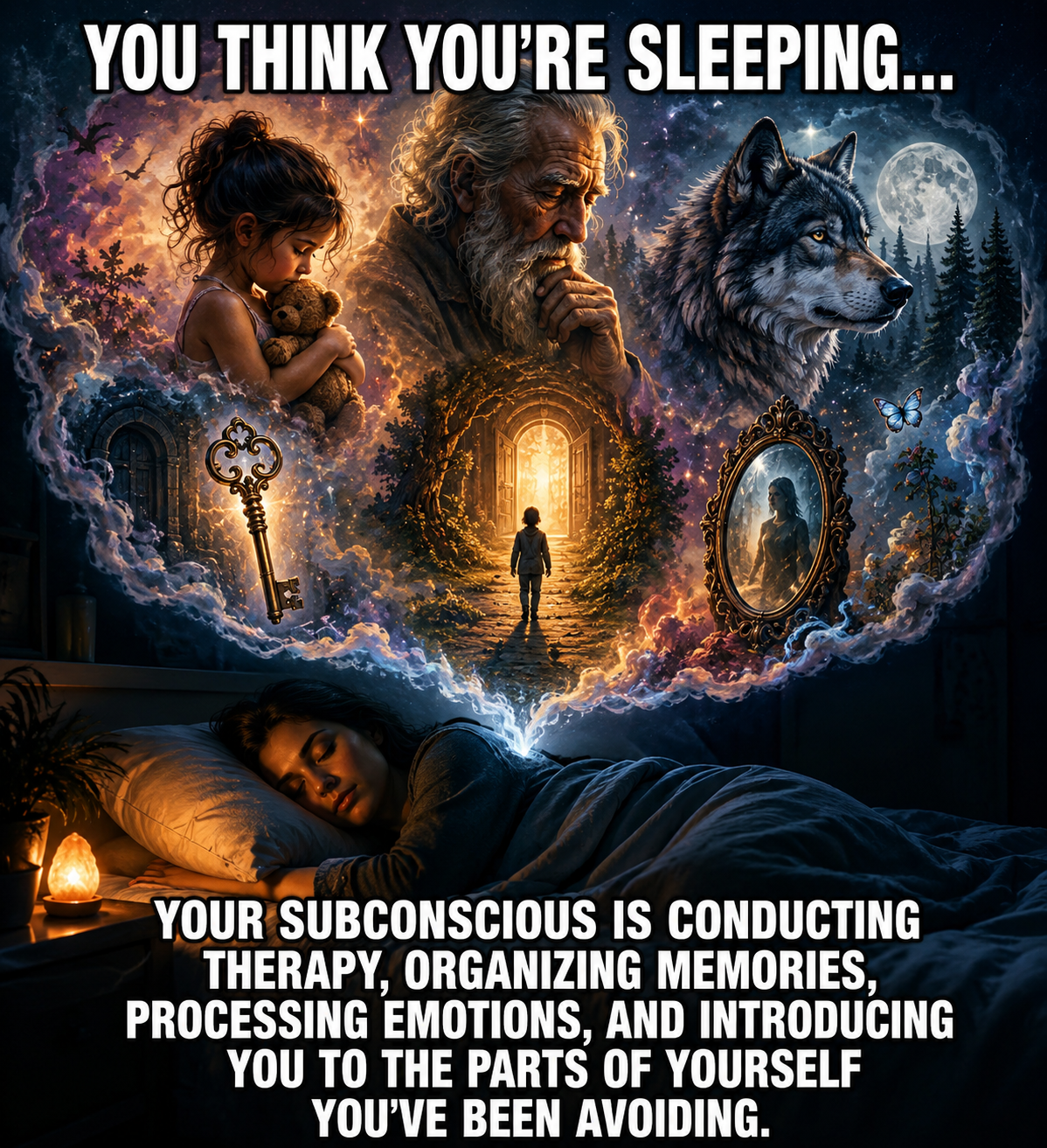
Every night, as the body falls asleep and the conscious mind releases its grip on the world, another part of us awakens. Beyond the noise of daily life, beyond our routines, beliefs, and identities, the deeper mind begins to speak. It speaks not in words, but in symbols, emotions, stories, and experiences we call dreams.
Many people dismiss dreams as random images generated by the brain. Yet throughout history, mystics, philosophers, psychologists, and spiritual seekers have viewed dreams differently. They understood that dreams often reveal what the waking mind cannot see.
This is where shadow work begins.
In psychology, particularly through the work of Carl Jung, the shadow refers to the parts of ourselves that we do not fully recognize, accept, or express. These can include fears, wounds, desires, talents, emotions, beliefs, and even positive qualities that have been pushed outside of conscious awareness. The shadow is not something evil or dark. Rather, it is the unseen portion of ourselves waiting to be understood.
During waking life, the conscious mind acts as a filter. It helps us navigate the world, maintain our identity, and focus on what seems most important. Yet this filtering process also pushes certain experiences, emotions, and memories into the background. During sleep, those filters relax. The unconscious mind is given more freedom to communicate through symbols, people, animals, places, emotions, and stories. A dream may present aspects of ourselves that are seeking understanding, healing, or integration.
Interestingly, modern science has begun to uncover mechanisms that support this idea.
From a scientific perspective, dreams occur primarily during Rapid Eye Movement (REM) sleep, although dreaming can occur during other sleep stages as well. During REM sleep, areas of the brain involved in emotion, memory, imagination, and visual processing become highly active, while regions responsible for critical thinking and self-monitoring become less active. This creates the vivid, emotional, and often symbolic experiences we remember as dreams.
Scientists have proposed several reasons why we dream. One of the strongest theories is memory consolidation. During sleep, the brain sorts through the events of the day, strengthening important memories and discarding unnecessary information. Dreams may reflect this process as the mind weaves together experiences, emotions, and associations.
Another leading theory involves emotional processing. Research suggests that dreams help us work through emotionally significant experiences. The sleeping brain revisits situations involving fear, grief, joy, anxiety, or conflict in a setting where stress hormones are reduced. Some researchers have even described dreams as a form of overnight therapy.
Dreams may also enhance creativity and problem-solving. Free from the constraints of ordinary logic, the dreaming mind can form connections that might never arise during waking consciousness. Throughout history, artists, inventors, scientists, and visionaries have credited dreams with providing insights that changed their lives.
When viewed through the lens of shadow work, these scientific theories become particularly fascinating.
Science tells us that dreams often process unresolved emotions, significant memories, social relationships, personal concerns, fears, and desires. Shadow work suggests that dreams reveal unconscious beliefs, hidden emotions, and aspects of ourselves that are seeking integration. While the language differs, both perspectives point toward a remarkably similar conclusion: dreams frequently bring unconscious material into conscious experience.
Dreams are often mirrors disguised as stories.
A frightening dream may reveal a fear we have avoided. A dream about an old friend may symbolize a forgotten aspect of ourselves. A talking animal, a mysterious stranger, or a long-lost home may represent qualities within our own psyche seeking recognition. The people we meet in dreams frequently embody aspects of ourselves. The places we visit may represent inner landscapes. Even conflict within a dream can mirror conflict between different parts of our personality.
This is why dream symbolism is so personal.
Science does not support the idea of a universal dream dictionary where every symbol has the same meaning for everyone. A dog in one person’s dream may symbolize loyalty, while for another it may represent fear or a cherished memory. The meaning depends on the dreamer’s own experiences, emotions, and associations.
Spiritual traditions have long pointed toward this same process of inner integration. The Law of One speaks of balancing and accepting all aspects of the self. Taoism teaches harmony between apparent opposites. The Gospel of Thomas speaks of making “the two one.” Though expressed in different languages, these teachings point toward a common truth: healing occurs when what has been divided becomes whole.
Shadow work is not about eliminating darkness. It is about bringing awareness to what has been hidden.
A dream may reveal anger that seeks understanding rather than suppression. It may uncover grief waiting to be healed. It may expose inherited beliefs that no longer serve us. Sometimes it reveals strengths, talents, and wisdom we have never fully embraced. The shadow contains both the wounded child and the forgotten king.
Perhaps this is why some dreams stay with us long after we awaken. They are not merely random events. They are invitations.
An invitation to know ourselves more deeply.
An invitation to integrate what has been divided.
An invitation to discover that the parts of ourselves we once rejected may hold the very wisdom we have been seeking.
Science may describe dreams as the brain’s process of memory integration, emotional regulation, creativity, and psychological maintenance. Spiritual traditions may describe them as messages from the deeper self or the soul. While the interpretations differ, both perspectives arrive at a similar insight: dreams are doing important work while we sleep.
The next time you awaken from a vivid dream, resist the urge to dismiss it. Sit quietly for a moment and ask yourself:
“What part of me is this dream trying to show me?”
The answer may reveal that your greatest teacher was speaking to you all along—not from a mountaintop, a sacred text, or an outside authority, but from within the unexplored landscape of your own consciousness.
For every night, while the body sleeps, the journey toward wholeness continues.
Leave a Reply