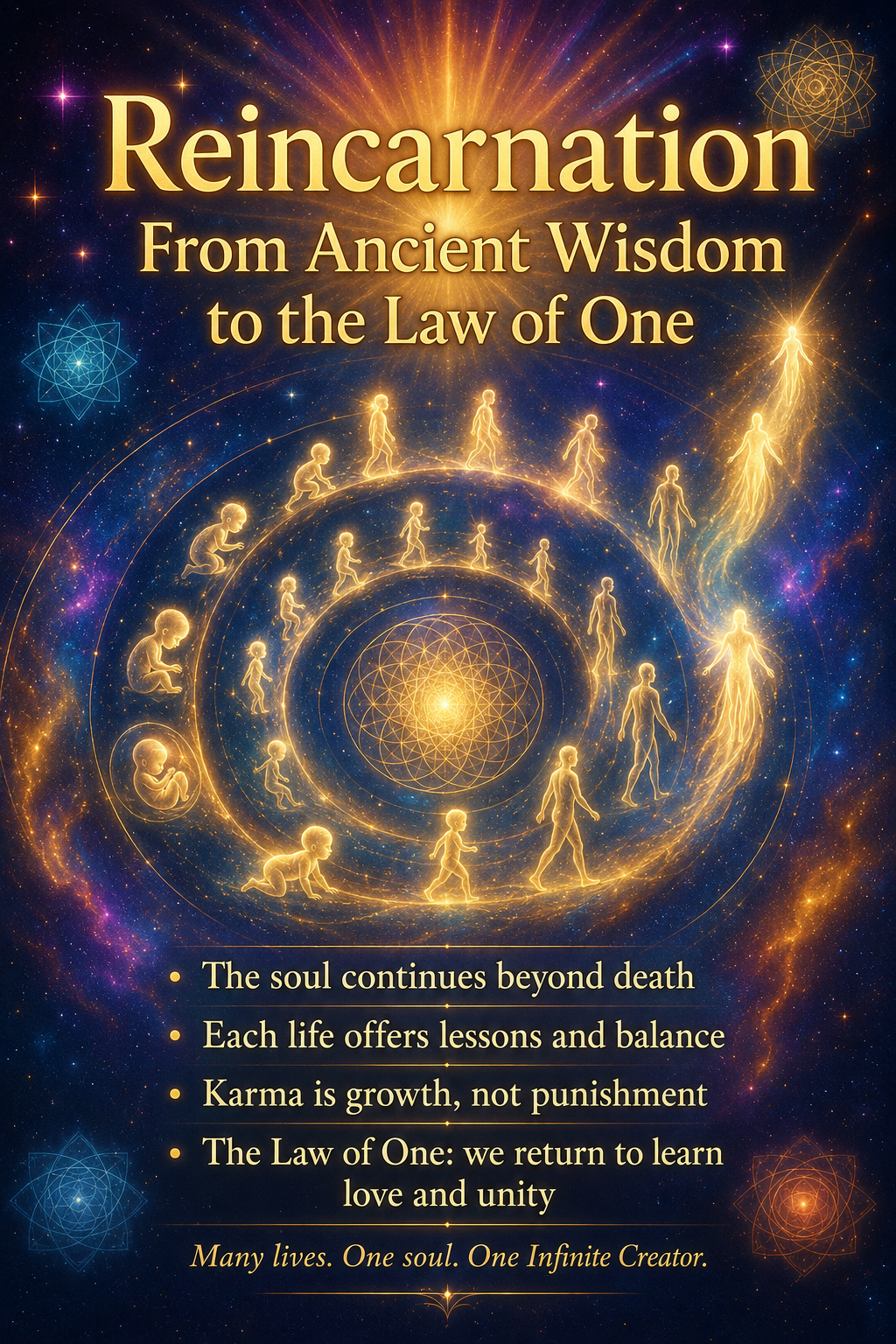
Reincarnation is one of humanity’s oldest spiritual ideas: the belief that death is not the end of consciousness, but a transition. The body falls away, while the deeper self continues—learning, healing, and eventually returning to experience another life.
Although different traditions use different language, many describe life as a school for the soul. We are not here merely to survive, accumulate, or suffer. We are here to evolve.
Ancient Roots of Reincarnation
The idea appears in some of the earliest spiritual traditions.
In ancient India, reincarnation became central to Hindu thought. The Upanishads taught that the eternal Self, or Atman, is not destroyed at death. The body changes, but the deeper consciousness continues. The Bhagavad Gita compares this process to changing clothing:
“As a person puts on new garments, giving up old ones, the soul accepts new material bodies, giving up the old and useless ones.”
Life after life, the soul moves through experiences shaped by karma—not as punishment, but as the natural return of energy, choices, beliefs, and unfinished lessons.
Buddhism also speaks of rebirth, though it does not describe a permanent individual soul in exactly the same way. Instead, it teaches that patterns of consciousness, attachment, desire, fear, and conditioning continue. Liberation comes when the cycle of unconscious rebirth is no longer necessary.
Ancient Greek philosophers also explored reincarnation. Pythagoras taught that the soul was immortal and moved through different lives. Plato wrote of souls choosing new incarnations based on their development and tendencies. In The Republic, Plato tells the Myth of Er, where souls review previous lives, choose future circumstances, and return to Earth.
This is surprisingly close to modern spiritual ideas that the soul may participate in choosing its major life themes before incarnation.
Reincarnation in Jewish, Christian, and Gnostic Thought
Reincarnation is not usually emphasized in mainstream modern Christianity, but ideas resembling it appear around the edges of Jewish and early Christian thought.
The Hebrew Bible contains passages that some interpreters see as suggestive of return or continuation, though they are not direct teachings of reincarnation. By the time of Jesus, some people clearly believed that a prophet could return in a new form. When Jesus asked his disciples who people said he was, they answered that some believed he was John the Baptist, Elijah, Jeremiah, or another prophet returned.
Jesus also said of John the Baptist:
“And if you are willing to accept it, he is Elijah who was to come.”
This was connected to the prophecy that Elijah would return before the coming of the Messiah.
Whether this meant literal reincarnation, spiritual succession, or John carrying the same prophetic spirit is debated. But it shows that the concept of a soul or spiritual identity returning was not entirely foreign in that world.
Some early mystical Jewish teachings, especially later Kabbalah, explicitly included gilgul neshamot—the cycling or “rolling” of souls through multiple lifetimes. In that view, souls may return to complete unfinished spiritual work, repair distortions, or fulfill aspects of their purpose.
Gnostic traditions also often viewed earthly life as part of a larger journey of awakening. The central problem was not simply sin in the legal sense, but spiritual forgetfulness. Humanity had forgotten its divine origin. Awakening meant remembering: I am more than this body, this personality, this fear, this one lifetime.
That idea strongly parallels the Law of One.
Reincarnation as Soul Education
Across many traditions, reincarnation is not presented as random. It is purposeful.
A soul may return to learn compassion after a life of power without empathy. It may return to understand humility after pride. It may experience vulnerability after having caused harm. It may choose a difficult life not because it is being punished, but because certain conditions create the possibility for growth, forgiveness, courage, service, or awakening.
This does not mean every hardship is “deserved.” That idea can become cruel and simplistic.
A better spiritual understanding is that incarnation occurs within a field of free will, collective karma, family patterns, cultural conditioning, and soul-level intention. A person may enter difficult circumstances because they offer potent opportunities, but the person still has freedom in how they respond.
The lesson is not always, “Why did this happen to me?”
Sometimes the deeper question is, “What is this experience calling forth in me?”
The Law of One View
The Law of One material presents reincarnation as part of a carefully designed system of spiritual evolution.
According to Ra, each person is a mind/body/spirit complex moving through many incarnations. The deepest self is not the personality of this lifetime. The personality is more like a temporary costume, role, or instrument through which the soul learns.
Between incarnations, the entity reviews the life it has just lived. It sees more clearly where it loved, where it withheld love, where it acted from fear, where it served others, and where it became trapped in distortion.
The next incarnation is then planned with the help of higher spiritual guidance.
This planning may include:
- family relationships
- body limitations or strengths
- opportunities for service
- recurring emotional themes
- catalysts such as loss, illness, conflict, poverty, abundance, or unusual abilities
- people with whom unfinished lessons remain
- situations designed to balance old distortions
Ra emphasizes that incarnation is not a courtroom. It is a classroom.
The soul is not being judged by an angry external God. It is learning how to know itself as love.
The Veil of Forgetting
One of the most important teachings in the Law of One is the “veil of forgetting.”
Before entering this life, the soul may know its lessons, relationships, and possible pathways. But once incarnated, much of that knowledge is hidden.
Why?
Because growth has greater meaning when it occurs through free choice.
If you remembered every past life, every agreement, every reason behind every painful event, it would be much easier to make the “correct” spiritual choice. But it would be less freely chosen.
The veil creates uncertainty. It allows faith, intuition, compassion, courage, and love to arise from within.
This is why dreams, synchronicities, deep meditation, symbolic encounters, and moments of profound recognition can feel so meaningful. They may be small openings in the veil—not necessarily literal messages to be interpreted rigidly, but reminders that life is larger than the surface story.
Karma in the Law of One
The Law of One does not portray karma as punishment. It speaks more in terms of balance.
When we act in ways that violate our own deeper knowing, we create distortions. If we dominate, manipulate, abandon, hate, or refuse love, the soul may eventually seek an experience that helps it understand the energy it created.
This does not mean someone who suffers has done something wrong in a former life. It means that consciousness seeks balance over long periods of development.
The purpose is restoration.
A person who once misused power may return in a life where they feel powerless—not as revenge, but to develop empathy. Someone who was emotionally closed may return with a sensitive heart. Someone who depended on control may face uncertainty until surrender becomes possible.
The soul is always moving toward greater integration.
Relationships Across Lifetimes
The Law of One suggests that people often reincarnate in groups. Family members, friends, rivals, partners, teachers, and even enemies may return to one another in different roles.
A person who was your parent in one life may be your child in another. Someone who harmed you may return in a situation where forgiveness becomes possible. A person you deeply love may come back again and again because the connection contains shared service, learning, or healing.
This can help explain why some relationships feel instantly familiar.
You may meet someone and feel as though you have known them forever. You may feel an immediate bond, an unexplained resistance, a powerful attraction, or an old wound activated by someone you barely know.
That does not prove a past-life connection, but spiritually it can be useful to ask: What is this relationship teaching me about love, boundaries, forgiveness, truth, or myself?
The Purpose of Reincarnation: Choosing Love
In the Law of One, the major lesson of third density—the human stage of consciousness—is making a fundamental orientation toward service to others or service to self.
This is not simply about being “nice.” It is about the direction of one’s consciousness.
Do I use life mainly to control, protect, acquire, and dominate?
Or do I increasingly use life to understand, serve, heal, create, forgive, and love?
Most people are mixed. We all have fear, ego, wounds, and moments of self-protection. The point is not perfection. The point is direction.
Each life gives the soul countless chances to choose again.
A difficult relationship can become an opportunity to love without losing oneself. A fear can become an opportunity for courage. A wound can become compassion. A limitation can become humility. A loss can become awakening.
From this perspective, reincarnation is not about endlessly repeating lives. It is about gradually remembering who we are.
The Deepest Meaning
The ancient traditions and the Law of One meet at a similar conclusion:
You are more than your current personality.
You are more than your mistakes.
You are more than your body, fears, roles, beliefs, and history.
This life matters deeply, not because it is the only chapter, but because it is the chapter you are living now. Every choice, every act of forgiveness, every moment you choose truth over fear contributes to the evolution of the soul.
Reincarnation is not an excuse to postpone growth.
It is a reminder that growth is never wasted.
The soul does not ask, “Did you become perfect?”
It asks, “Did you become more loving? Did you remember who you are? Did you use this life to move closer to unity?”
And from the Law of One perspective, the final answer is always the same:
There is only one being here, learning to recognize itself through many faces.
Leave a Reply