Listening to Neil deGrasse Tyson, who is an astrophysicist, author, and science communicator known for making complex scientific ideas understandable to the public. His commentaries about God opened the door to many ideas and questions in my own mind—not because he was necessarily presenting a spiritual explanation, but, in his view, because science, when taken far enough, eventually brings us to the edge of mystery. Perhaps sometimes science simply has to catch up.
Science can describe the development of stars, galaxies, planets, and biological life. It can investigate the history of the observable universe and trace physical conditions back toward an extremely hot and dense early state. Yet beneath all these discoveries remains a deeper philosophical question:
Why is there something rather than nothing?
That question has led me to a central idea that I have been researching for years through ancient texts, mystical traditions, world religions, and The Law of One:
Existence must ultimately rest upon something that is not merely another object within existence.
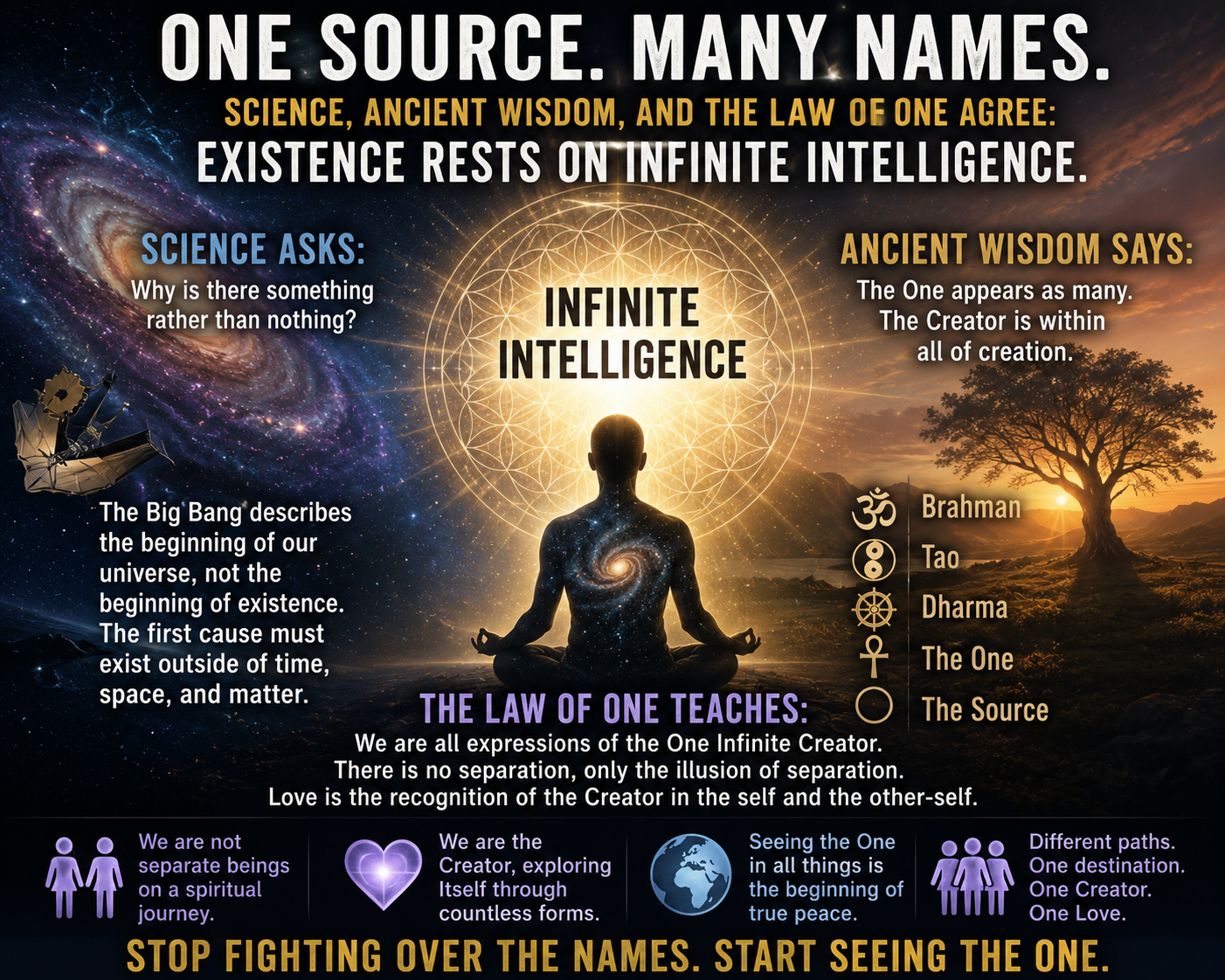
Let’s call that underlying reality Infinite Intelligence.
Infinite Intelligence is not simply one more being somewhere in the universe. It is not an object that exists alongside stars, planets, atoms, people, or gods. It is the uncreated foundation from which consciousness, energy, matter, natural law, space, time, and all forms of existence arise.
From the perspective of The Law of One, the manifested creation—galaxies, densities, mind/body/spirit complexes, space/time, time/space, and every form of experience—does not exist independently. It rests upon what Ra calls Intelligent Infinity, the undifferentiated reality of the One Infinite Creator.
What Created God?
One of the oldest questions asked about religion is deceptively simple:
If God created everything, what created God?
The traditional religious answer is that God was never created. God always existed. God has no beginning and no end and exists beyond the limitations of time.
But this answer raises another question. When someone proposes that the universe, existence, energy, or reality itself might be eternal, religious believers sometimes respond that everything must have a creator.
So which is it?
If absolutely everything requires a creator, then God would also require one. Whatever created God would then need another creator, followed by another, and the chain would continue forever.
This is known as an infinite regress.
Yet something exists. We are here. The universe is here. Consciousness is here. Therefore, at some level, reality must rest upon something that does not receive its existence from something else.
The more precise theological argument does not claim that everything requires a creator. It claims that everything that begins to exist—or everything that is contingent and dependent—requires an explanation.
God is then defined not as one more created being, but as necessary existence itself: that which exists through its own nature and does not receive existence from anything else.
But this immediately introduces another challenge:
Why assign necessary existence to a personal God rather than to the universe, consciousness, existence itself, or some deeper infinite reality?
That is where traditional religion, ancient mysticism, philosophy, and The Law of One begin to move in different directions.
What Science Can and Cannot Tell Us
It is important not to claim more for science than science itself claims.
Modern science does not universally conclude that a conscious first cause existed before the Big Bang. Scientists also do not know with certainty that there was literally “nothing” before the Big Bang.
The Big Bang theory describes the early development and expansion of our observable universe from an extremely hot and dense condition. It does not necessarily describe the absolute beginning of all possible reality.
The word before may itself become problematic because time, as we understand it, is part of the universe being investigated. If time emerged with the universe, asking what happened “before time” may be like asking what lies north of the North Pole.
There are scientific hypotheses involving cosmic inflation, quantum cosmology, cyclic universes, multiverses, and other possibilities. None has yet provided a universally accepted answer to why reality exists in the first place.
Science is extremely powerful at answering questions about how observable processes work. The deeper question of why there is existence rather than nonexistence may belong partly to philosophy and metaphysics.
That does not mean we should insert God wherever scientific knowledge is incomplete. It means we should honestly recognize where knowledge ends and mystery begins.
The First Cause and the Ground of Being
Philosophers have often referred to the ultimate foundation of existence as the First Cause, the Unmoved Mover, necessary being, or the ground of being.
However, the phrase “first cause” can be misleading if we imagine the source as the first event in a sequence of events.
An event occurs within time. But if time itself belongs to the created order, the source of time cannot merely be an earlier event occurring at a previous moment.
The ultimate source would not simply stand at the beginning of a timeline. It would be the reality upon which the entire timeline depends.
It would be closer to the ground supporting every moment than to the first link in a chain.
This source would not ask, “What happened before me?” because the concepts of before and after would arise within it.
This is what I mean by Infinite Intelligence.
The Biblical View of the Uncreated God
The Book of Genesis begins:
“In the beginning God created the heavens and the earth.”
God is presented as existing prior to the ordered world, but Genesis does not attempt to explain where God came from. God is assumed to be the uncreated source of creation.
A deeper suggestion appears in the divine name revealed to Moses, commonly translated as:
“I Am That I Am.”
This can be understood as more than the name of a supernatural personality. It points toward pure being: not “I was created,” not “I became,” but simply I AM.
In this interpretation, God is not merely a being. God is Being itself.
Also in the Book of Genesis “Let us make mankind in our image,” the plural language suggests that creation involved more than the image of a solitary humanlike deity. Biblical scholars often connect it with an ancient divine council, while Christians later interpreted it through the Trinity. From the perspective of The Law of One, it may reflect the many creative intelligences or Logoi working within the unity of the One Infinite Creator. Humanity is therefore made not in the physical appearance of God, but with the spiritual qualities of consciousness, creativity, free will, and the capacity to know the Creator within.
From the perspective of The Law of One, the words “Let us make mankind in our image” could be interpreted as referring to a group of higher intelligences involved in humanity’s development rather than to the One Infinite Creator speaking as a solitary humanlike deity.
Ra describes a group associated with Yahweh as having worked with souls transferred from Mars and making genetic adjustments to the physical bodies through which they would incarnate. The material even states that some entities incarnated “in the image of Yahweh.” In that sense, the plural words “let us” and “our image” could reflect the activity of a collective consciousness, social memory complex, or group of Confederation-related beings working within creation.
However, these beings would not be the ultimate Creator. They would be advanced participants within creation, acting—successfully or unsuccessfully—in service to humanity. The One Infinite Creator would remain the source of both humanity and the beings involved in shaping the human physical form.
This interpretation does not prove that Genesis refers to the Confederation, but it offers a meaningful way to understand why the passage uses plural language: “Let us make mankind in our image.”
However, much of traditional religion has pictured God as a supreme individual who stands outside the universe, creates it like a craftsman, rules it from a distance, judges humanity, rewards obedience, and punishes disobedience.
This image may contain spiritual meaning, but it also creates a strong division between Creator and creation.
Ancient mystical traditions often go further. They suggest that the source does not merely create the universe from the outside. The source expresses, emanates, or reveals itself as creation.
The Gods of the Ancient Near East
Ancient Mesopotamian texts present a different picture from the opening of Genesis.
In stories such as the Enuma Elish, gods emerge from earlier primordial realities associated with water, chaos, and undifferentiated existence. These deities are born, develop relationships, compete, fight wars, and establish systems of authority.
They are powerful, but they are not necessarily ultimate.
They exist within a larger cosmic process.
This distinction is essential:
A god may be a powerful being within creation without being the Infinite Source of creation.
A sufficiently advanced being could appear divine to a less advanced civilization. It might possess extraordinary knowledge, technology, psychic ability, or influence. Human beings might worship such a being, preserve stories about it, and eventually identify it as the supreme creator.
But power does not equal infinity.
A being who has a personality, history, location, preference, conflict, or limitation remains a being within existence. It is not necessarily the ground of existence itself.
This relates to my study of the Anunnaki and other ancient divine figures. Even if some ancient accounts preserve memories of encounters with advanced beings, those beings would still belong to creation. They would not automatically be the One Infinite Creator.
Within the interpretive framework of The Law of One, names such as Yahweh may refer to complicated layers of spiritual contact, cultural interpretation, and historical distortion rather than a simple identification with the totality of the Infinite Creator. This is a metaphysical interpretation, not an established historical or scientific conclusion.
The important distinction is between a god and the Infinite Source from which all gods, beings, universes, laws, and forms of consciousness arise.
The Gospel of Thomas and the Kingdom Within
The mystical teachings attributed to Jesus in the Gospel of Thomas move closer to unity than the ordinary idea of a creator separated from creation.
The kingdom is not presented only as a distant place controlled by an external ruler. It is within us and around us, but humanity does not recognize it.
The light is already present. The problem is not that God is absent. The problem is that human beings do not perceive the divine reality surrounding and living through them.
This changes the question.
Instead of asking only:
Who built the universe?
we begin asking:
What is the living reality appearing as the universe—and appearing as us?
The Gospel of Thomas emphasizes recognition. Human ignorance creates the experience of separation. Knowledge of the true self becomes connected with knowledge of the divine source.
This does not mean that the ordinary human personality is the whole of God. It means that the deepest life within us is not separate from the source of life itself.
The kingdom is not merely somewhere else.
The kingdom is hidden in plain sight.
The Gnostic Distinction Between the Source and the Creator
Several Gnostic writings make a clear distinction between the highest, unknowable source and a lesser being who fashions or governs the material world.
In texts such as The Secret Book of John, the ultimate source is beyond names, forms, categories, personality, time, and ordinary thought.
It does not create like a human craftsman constructing an object.
Reality unfolds from it through successive levels of emanation and consciousness.
The lesser creator, commonly called the Demiurge, believes himself to be the highest God because he cannot perceive the greater reality from which he originated.
Whether we interpret this account literally, psychologically, symbolically, or metaphysically, it introduces a profound distinction:
- The maker or organizer of a particular world is not necessarily the ultimate source.
- A powerful ruler is not necessarily Infinite Intelligence.
- A being who demands worship is not necessarily the ground of all being.
- The highest reality cannot be confined to the personality of a lesser deity.
The Gnostic tradition therefore helps answer part of the creator problem.
The ultimate source is not merely a being.
It is closer to Being itself.
Brahman and the Infinite Reality
The Upanishadic concept of Brahman closely resembles the underlying reality I call Infinite Intelligence.
Brahman is the infinite, eternal reality beneath every form. It is not merely one object among other objects. It is the foundation and essence of all existence.
The individual self, or Atman, is ultimately not separate from Brahman.
This does not mean the ordinary ego is the Supreme Reality. It means that beneath the temporary personality lies a deeper consciousness whose essential nature belongs to the same ultimate reality present throughout creation.
The universe is not necessarily identical to Brahman in a narrow materialistic sense. Rather, the universe exists within Brahman and expresses Brahman, while Brahman exceeds every particular form and manifestation.
A wave is made entirely of ocean, but the ocean is greater than any single wave.
Likewise, each being may be an expression of Infinite Intelligence without containing or exhausting the totality of Infinity.
Buddhism and Dependent Origination
Buddhism approaches these questions differently. It generally does not require an eternal creator deity or a single first cause.
Instead, Buddhism teaches dependent origination: phenomena arise because of conditions. Nothing exists as a completely independent, permanent, self-contained entity.
Everything is relational.
Everything is connected.
Everything is becoming.
Mahayana Buddhist teachings about emptiness do not necessarily mean that nothing exists. Emptiness means that things are empty of separate, independent, permanent existence.
A tree depends upon soil, water, sunlight, atmosphere, seeds, time, and countless biological processes. A human being depends upon parents, food, culture, language, relationships, nature, and the entire history of life.
Nothing stands entirely alone.
In this way, Buddhism also challenges the idea that reality consists of isolated objects existing separately from one another.
Although Buddhism may not call the underlying mystery God or Infinite Intelligence, it also undermines the illusion of absolute separation.
Taoism and the Nameless Source
The Tao Te Ching begins with the recognition that:
The Tao that can be spoken is not the eternal Tao.
The ultimate source cannot be completely captured by names, doctrines, or definitions.
The Tao is described as prior to heaven and earth, nameless, inexhaustible, and the mother of the ten thousand things.
Yet the Tao is not ordinarily presented as a personal deity standing outside the universe and manufacturing it from a distance.
The Tao is the underlying Way through which existence arises, moves, changes, and returns.
It does not force creation.
It expresses itself naturally as creation.
The ten thousand things emerge from the Tao, exist through the Tao, and return to the Tao. The source and its expression are distinguishable, but they are never completely separate.
This is remarkably close to the idea that the universe is a manifestation of an underlying Infinite Reality.
The Law of One and Intelligent Infinity
The Law of One offers one of the clearest metaphysical frameworks I have found for bringing these ideas together.
Ra describes the primal reality as Intelligent Infinity, also called Infinite Intelligence or the One Infinite Creator.
Before differentiated creation, there is infinity. Infinity becomes aware. Through the first distortions of free will, Love or Logos, and Light, the many forms of creation arise.
Ra describes Intelligent Infinity as undifferentiated, whole, and ultimately mysterious. The Law of One material presents creation as an exploration of many-ness by the One, through which the Creator comes to know itself.
The crucial point is that the Creator does not remain outside creation as a separate builder.
The Creator becomes creation.
Every galaxy, star, planet, animal, person, atom, and field of consciousness is an expression of the One Infinite Creator exploring itself through apparent multiplicity.
From this perspective:
- God did not create a universe entirely separate from God.
- The universe is an expression of Infinite Intelligence.
- The Creator is present within every portion of creation.
- No individual portion contains the complete infinity of the Creator.
- We are portions of the Creator experiencing the illusion of separation.
- Spiritual evolution is the gradual remembrance that the Creator, creation, self, and other-self are one.
Therefore, the question “Who created God?” becomes somewhat misplaced.
The Infinite Creator is not a particular entity that appeared at some moment in time. It is the foundational reality within which time, beginnings, causes, objects, and individual entities arise.
Nothing created the Creator because the Creator is not one created thing among other things.
The Creator is the inexhaustible ground of existence itself.
Is the Universe God?
The idea that God and the universe are identical is generally called pantheism.
Pantheism says:
Everything is God, and God is everything.
The Law of One, however, appears closer to panentheism.
Panentheism says:
Everything exists within God, and God is present within everything, but God is greater than any single universe or manifestation.
This distinction matters.
A particular universe may have a beginning. It may expand, contract, transform, or eventually cease to exist in its present form.
But Infinite Intelligence would not be limited to one physical universe.
A wave is the ocean in expression, but the ocean is more than one wave.
A ray of sunlight is genuinely sunlight, but it is not the totality of the sun.
Likewise:
The universe is the Creator in manifestation, but the Infinite Creator cannot be confined to the visible universe.
This may reconcile the apparent conflict between saying that God is the universe and saying that God transcends the universe.
The Creator is both immanent and transcendent:
- present within everything,
- yet greater than every particular thing;
- expressed as creation,
- yet never exhausted by creation.
Why Humanity Became So Confused
If this underlying unity has been recognized by mystics, sages, prophets, and spiritual seekers throughout history, why have human belief systems moved so far into separation, conflict, fear, and control?
From the perspective of The Law of One, humanity is not necessarily off track by accident.
Confusion is built into the third-density experience.
Human beings are attempting to discover unity while living behind a veil that makes separation appear real.
That does not mean every mistaken belief is desirable. It does not mean cruelty, oppression, or religious violence should be excused.
It means Earth functions as an environment in which truth must be chosen rather than made obvious.
The Veil of Forgetting
According to Ra, third-density incarnation includes a veil between the conscious mind and the deeper mind.
We enter physical life without consciously remembering our previous incarnations, spiritual origins, life plans, or unity with the Creator.
We see separate bodies.
We develop separate identities.
We experience ourselves as isolated individuals competing for security, belonging, resources, recognition, and power.
Without the veil, recognizing the Creator in every person would be relatively easy. We would know that harming another is ultimately harming another expression of ourselves.
Behind the veil, however, unity is not obvious.
We must choose whether to:
- protect only ourselves,
- dominate other people,
- remain indifferent to suffering,
- or recognize the Creator within the other-self.
The forgetting gives our choices spiritual meaning.
Love offered when unity is hidden requires faith, courage, and inner recognition.
Mistaking the Symbol for the Reality
Religions often begin with someone’s encounter with mystery:
- Jesus experiences profound unity with the Father.
- The Buddha awakens to the nature of suffering and liberation.
- Hebrew prophets encounter the divine.
- Muhammad receives revelation.
- Hindu sages recognize Brahman.
- Taoist sages experience harmony with the Tao.
- Mystics enter states in which ordinary separation dissolves.
The original encounter may be genuine and transformative.
But that experience must then pass through human language, culture, memory, symbolism, politics, institutions, translation, and interpretation.
The infinite cannot be completely contained within words.
The moment an infinite experience is expressed through finite language, it becomes a distortion—not necessarily a falsehood, but a limited representation of something larger.
A description of God is not God.
A scripture about truth is not the totality of truth.
A symbol pointing toward the divine is not the divine reality itself.
The original message may be:
The Creator is within you. Love one another. Recognize the sacredness of all life.
Over time, institutions may transform it into:
Our interpretation is the only truth. Our group alone is chosen. Those outside our tradition are separated from God.
The map replaces the territory.
The symbol becomes more important than the reality toward which it originally pointed.
The Ego’s Need for Certainty
The human ego prefers certainty, identity, belonging, and control.
A fixed doctrine can provide psychological security. It tells people:
- who they are,
- where they belong,
- what they should believe,
- who possesses authority,
- what happens after death,
- and which people are right or wrong.
Religion can soften the ego by teaching humility, forgiveness, compassion, and service.
But the ego can also take possession of religion.
It can say:
My God, my scripture, my church, my nation, and my people possess the truth.
Spiritual belief then becomes another identity to defend.
Instead of dissolving separation, religion strengthens it.
Instead of leading people beyond the ego, doctrine becomes an instrument of the ego.
People may become more committed to being correct than to being loving.
Yet certainty can close the very door through which deeper understanding might enter.
Fear Is Easier to Use Than Love
Love requires freedom.
Control relies upon fear.
Throughout history, religious institutions have sometimes discovered that fear of punishment, damnation, exclusion, divine anger, or social rejection can influence people more effectively than an invitation to seek the Creator within themselves.
From the Law of One perspective, this can represent the service-to-self use of spiritual knowledge: manipulating others, strengthening hierarchy, and concentrating power.
This does not mean religion itself is evil.
It means any spiritual system can be used through either polarity.
A cross can represent sacrificial love—or conquest.
Scripture can awaken the conscience—or be used to dominate it.
A spiritual teacher can guide people toward their inner relationship with the Creator—or make followers dependent upon the teacher.
The same symbol may serve very different intentions.
Confusing Powerful Beings With the Infinite Creator
Many ancient gods behave like limited personalities.
They become jealous, angry, competitive, possessive, and violent. They favor particular tribes, demand obedience, fight rivals, and punish opposition.
Such beings, whether understood as literal entities, mythological figures, archetypal forces, or cultural projections, do not necessarily describe the Infinite Creator.
Within the Law of One framework, many levels of intelligent beings may exist. There may be higher-density entities, inner-plane teachers, advanced civilizations, Logoi, guardians, and negatively oriented beings.
But no individual entity is the totality of the One Infinite Creator.
Humanity may have encountered powerful beings and mistaken them for the ultimate God.
People may also have interpreted inner experiences through the language and expectations of their culture.
This could help explain why sacred texts sometimes contain magnificent teachings of love beside portrayals of jealousy, violence, tribal superiority, and domination.
Different experiences, voices, political interests, cultural memories, and levels of spiritual understanding may have been combined under one divine name.
When Living Truth Becomes an Institution
A mystic says:
I encountered the Divine.
The next generation says:
Let us preserve the mystic’s teaching.
The following generation says:
Here is the authorized interpretation of that teaching.
Eventually, the institution may say:
You can encounter God only through us.
A living experience becomes a doctrine.
The doctrine becomes a boundary.
The boundary becomes an organization.
The organization begins protecting its authority.
This pattern is not limited to religion. It can happen in governments, philosophies, sciences, political movements, and spiritual communities—including communities built around The Law of One.
Any teaching can become dogmatic when followers defend its language instead of embodying its central truth.
Even the statement “all is one” can become another belief used to judge people who do not accept it.
Service to Others and Service to Self
The Law of One does not describe existence as a simple battle between an all-good God and an equally powerful evil being.
Instead, it presents two basic orientations through which consciousness may develop.
Service to Others
Service to others recognizes unity.
It sees other beings as other expressions of the same Creator. It develops compassion, understanding, patience, forgiveness, humility, and respect for free will.
Service to Self
Service to self intensifies the experience of separation.
It seeks power through domination, control, manipulation, hierarchy, and the subordination of others.
Human religions often contain elements of both paths.
Some teachings emphasize:
- compassion,
- forgiveness,
- equality,
- freedom of conscience,
- service,
- and direct relationship with the Creator.
Other teachings emphasize:
- obedience,
- exclusion,
- superiority,
- punishment,
- fear,
- control,
- and unquestioned authority.
Most religious systems contain a mixture because human beings themselves contain a mixture.
The struggle is not merely between one religion and another. It occurs within every tradition and within every human heart.
Humanity Is Spiritually Young
In the Law of One framework, third density is not the culmination of spiritual development.
It is the density of self-awareness and moral choice.
Humanity has developed extraordinary intellectual ability, but intelligence does not automatically create wisdom.
We can split the atom before understanding our anger.
We can communicate instantly across the planet while remaining unable to listen compassionately to the person beside us.
We can study galaxies billions of light-years away while remaining unaware of our own motives.
We can create artificial intelligence while still struggling to understand consciousness itself.
Human beings are learning how to use self-awareness, personal power, and free will.
Our belief systems reflect that stage of development. They contain revelation mixed with tribalism, compassion mixed with fear, wisdom mixed with ego, and truth mixed with distortion.
Confusion as Catalyst
From this perspective, contradictory religions are not merely a cosmic mistake.
They also create catalyst.
A person raised to fear God may eventually ask:
Can Infinite Love eternally condemn a portion of itself?
A person taught that only one group possesses truth may encounter a loving and spiritually mature person from another religion.
A person harmed by religious authority may turn inward and discover a direct relationship with the Creator.
A person who loses faith in a traditional image of God may begin seeking the deeper reality that the image was attempting to represent.
The contradiction forces discernment.
We are not here merely to repeat what authorities tell us.
We are here to examine experience, listen inwardly, develop wisdom, choose our orientation, and gradually recognize truth for ourselves.
The Deepest Distortion Is Separation
Humanity has many religious disagreements, but from the perspective of The Law of One, the deepest distortion beneath them is the belief in separation:
- humanity separated from God,
- one religion separated from another,
- one race separated from another,
- one nation separated from another,
- humanity separated from nature,
- body separated from spirit,
- self separated from other-self,
- science separated from spirituality.
Once separation is accepted as ultimate, fear naturally follows.
Fear produces defense.
Defense produces competition.
Competition produces judgment.
Judgment can lead to control, domination, and violence.
The Law of One reverses this entire worldview:
There is only one Being appearing as many beings.
Therefore, harming another is ultimately harming another portion of oneself.
Serving another is serving the Creator.
Forgiving another is inseparable from forgiving the self.
Loving another is the Creator loving itself through two apparently separate lives.
Are We Truly Off Track?
At the human level, the answer is yes.
We have often transformed teachings of love into systems of division. We have used sacred language to justify violence, superiority, conquest, oppression, and control.
We have mistaken descriptions of God for God itself.
We have defended the container while forgetting what it was intended to contain.
At the level of the soul, however, The Law of One suggests that humanity is passing through a difficult but meaningful stage of awakening.
We are not lost somewhere outside the Creator.
There is nowhere outside the Creator to become lost.
We are the Creator temporarily experiencing what it feels like to believe we are separate.
The world’s religions may therefore be neither completely correct nor completely wrong. Each may preserve fragments of the same original recognition:
- Christianity speaks of union with God and the indwelling Spirit.
- Hinduism speaks of the relationship between Atman and Brahman.
- Buddhism challenges the illusion of a separate, permanent self.
- Taoism teaches harmony with the underlying Way.
- Sufism speaks of the lover returning to the Beloved.
- Gnostic traditions speak of the divine light within.
- The Gospel of Thomas points toward the kingdom within and around us.
- The Law of One teaches that all beings and all things are expressions of the One Infinite Creator.
The trouble begins when a fragment declares itself to be the whole.
A More Complete Understanding of God
The traditional religious image presents God as an eternal being who existed before everything and then created a universe separate from himself.
Ancient mystical traditions go deeper.
They describe the ultimate source as:
- unknowable Being,
- Brahman,
- Tao,
- the Monad,
- divine light,
- pure consciousness,
- the ground of being,
- or Infinite Intelligence.
The Law of One goes further by saying that creation is the Infinite Creator knowing and experiencing itself.
The deepest answer may therefore not be:
God existed before everything and then created it.
It may be:
There has never been anything other than the One Infinite Reality. What we call God, consciousness, energy, matter, life, nature, and the universe are different expressions of that one reality.
Nothing created the Creator because the Creator is not one object among other objects.
The Creator is the inexhaustible reality within which objects, causes, beginnings, time, space, consciousness, and creation arise.
The Mystery of the One and the Many
Perhaps the greatest mystery is not simply why God exists.
Perhaps the deeper mystery is why the One appears as the many.
Why would Infinite Intelligence express itself through countless galaxies, stars, planets, beings, and levels of consciousness?
Why would unity veil itself and experience separation?
Why would the Creator temporarily forget itself?
The Law of One offers a profound answer:
The Creator becomes the many in order to know itself through experience.
The Infinite explores every possibility through finite points of awareness.
Through us, the Creator experiences love and fear, joy and sorrow, courage and uncertainty, loss and reunion, forgetting and remembrance.
Every lifetime becomes a unique window through which the Infinite looks upon itself.
Every relationship allows the Creator to encounter another face of itself.
Every act of compassion becomes unity recognizing unity.
Every moment of awakening becomes the One remembering what it has always been.
The final goal may not be to escape creation or reject human life.
It may be to awaken within creation and recognize the Infinite Intelligence already present in everything.
The purpose is not to discover which religious institution owns God.
The purpose is to remember that no institution can own the Creator—and that the Creator lives within every person we meet.
Conclusion: Different Names for One Mystery
Science, philosophy, religion, ancient texts, and mystical traditions do not all provide the same answers.
They use different methods, languages, assumptions, and standards of evidence.
Science studies observable reality.
Philosophy examines reason and existence.
Religion preserves stories, revelations, symbols, and communal traditions.
Mysticism seeks direct experience of the sacred.
The Law of One offers a channeled metaphysical framework centered on unity, free will, spiritual evolution, and the One Infinite Creator. It should be understood as spiritual-philosophical material rather than established science or verifiable history.
Yet all these approaches can bring us to the edge of the same mystery:
Why does anything exist?
My own research has led me to believe that existence must rest upon something that is not merely another object within existence.
I call that reality Infinite Intelligence.
Religion may call it God.
Philosophy may call it necessary being or the ground of existence.
Taoism calls it the Tao.
The Upanishads call it Brahman.
Gnostic traditions call it the unknowable Source or Monad.
The Law of One calls it Intelligent Infinity and the One Infinite Creator.
The names are different.
The symbols are different.
The belief systems are different.
But perhaps, beneath the differences, humanity has been reaching toward the same Infinite Reality all along.
And perhaps spiritual awakening begins when we stop fighting over the names and begin recognizing the One within ourselves, within one another, and within everything that exists.
Leave a Reply