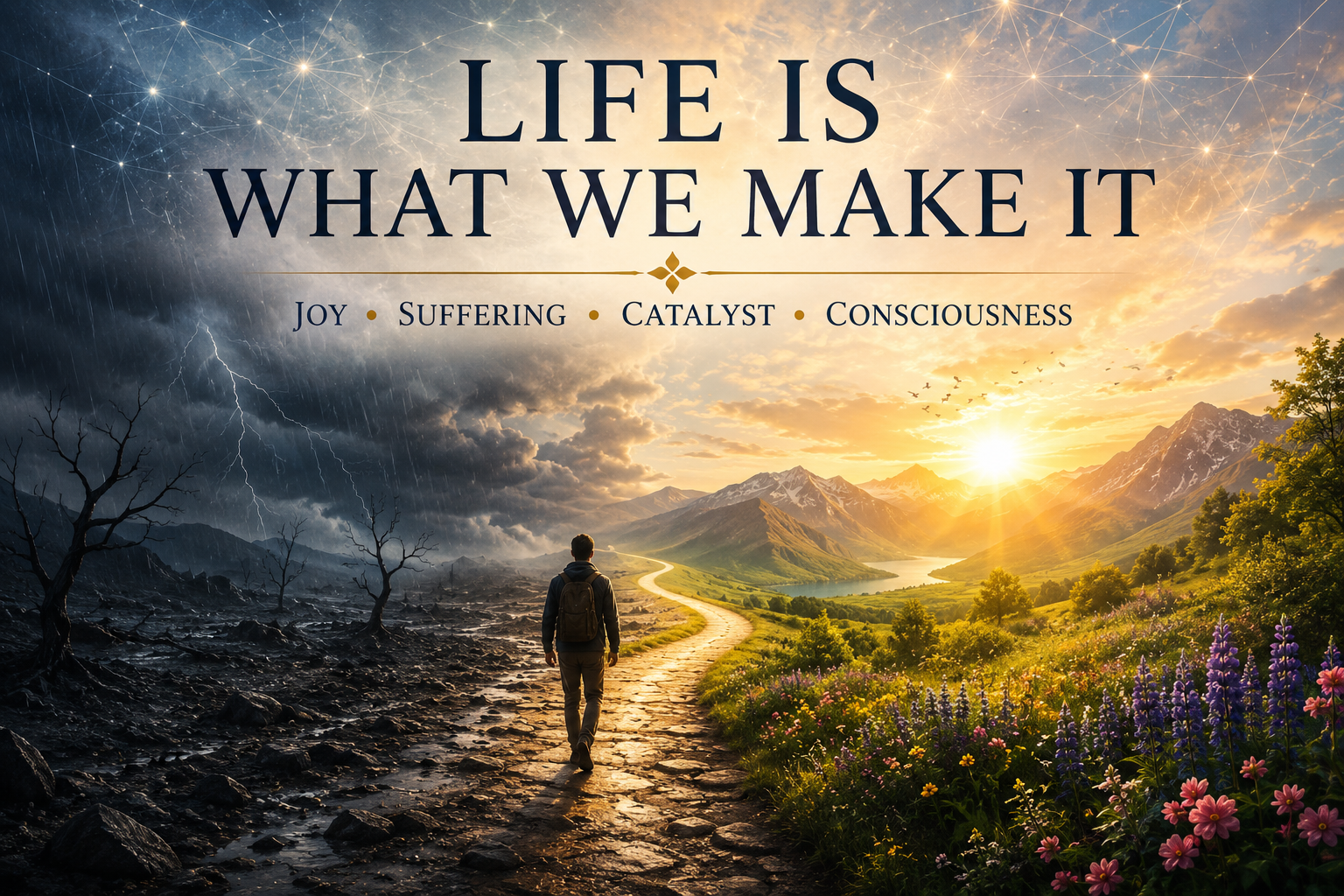
Life can be full of joy, with moments of pain and suffering that seemingly last a lifetime.
But life is what we make of it.
That simple statement contains one of humanity’s oldest spiritual questions:
If life contains both extraordinary beauty and profound suffering, what are we supposed to learn from it?
For thousands of years, religions, philosophers, mystics, and spiritual seekers have wrestled with this question. Christianity speaks of suffering, transformation, love, and the Kingdom of God. Buddhism begins with the reality of suffering and teaches a path toward liberation from our attachment to it. The Law of One describes the experiences of life as catalyst through which consciousness evolves.
These traditions are not identical, and we should not force them into one belief system. Yet beneath their different languages, there are fascinating similarities that invite deeper reflection.
Each, in its own way, asks us to look beyond what happens to us and examine what happens within us—a shift in perspective that becomes the thread connecting everything that follows.
Jesus and the Kingdom Within
Beginning with Christianity, we encounter a teaching that does not deny suffering but reframes its significance.
Jesus never promised that human life would be free from suffering.
His own life, according to the Gospel accounts, included rejection, betrayal, grief, physical suffering, and death.
Yet at the center of his teaching was love.
Love God.
Love your neighbor.
Love even your enemies.
Forgive.
Serve.
Care for those who suffer.
Rather than allowing suffering to determine who we become, Jesus continually redirected attention toward our inner response.
One of the most intriguing sayings attributed to Jesus concerns the Kingdom of God.
In Luke 17:21, depending upon the translation, Jesus says that the Kingdom of God is “within you” or “in your midst.”
Either translation points toward something profound.
The Kingdom is not merely a distant destination.
Something sacred is already present.
This idea naturally leads to a deeper question: if the Kingdom is already present in some form, then spiritual transformation may not be about escaping life, but about awakening within it.
Perhaps spiritual transformation begins when we recognize that our relationship with the Divine is not found only in external institutions, doctrines, or rituals, but also through the transformation of consciousness itself.
Jesus repeatedly emphasized the condition of the heart.
What do we love?
What do we fear?
What do we forgive?
How do we treat others?
What do we do when life wounds us?
Those questions remain as relevant today as they were two thousand years ago—and they form a bridge to another tradition that begins from a different starting point but arrives at a similar inward focus.
Buddhism and the Reality of Suffering
While Christianity emphasizes love and transformation of the heart, Buddhism begins by directly confronting the nature of suffering itself.
More than five centuries before Christianity, Buddhism began with an equally profound observation:
Human life contains suffering and dissatisfaction.
The Buddha called this dukkha.
Dukkha does not mean that everything in life is miserable. Buddhism recognizes happiness, beauty, love, friendship, and pleasure.
The deeper problem is that everything within the physical world changes.
People change.
Bodies age.
Relationships change.
Possessions disappear.
Health changes.
Those we love eventually leave us—or we leave them.
Even joyful experiences cannot be held forever.
Where Christianity often emphasizes how we respond through love and faith, Buddhism examines why suffering arises in the first place.
According to Buddhist teaching, much of our suffering comes not simply from change itself, but from our attempt to cling to what cannot remain unchanged.
We want pleasant experiences to continue.
We want painful experiences to disappear.
We want life to conform to our expectations.
When reality refuses, we suffer.
The Buddhist path therefore encourages awareness.
Observe the experience.
Observe the emotion.
Observe the attachment.
Observe the mind reacting.
Instead of becoming completely identified with every thought and emotion, we learn to witness them.
This does not mean becoming indifferent.
It means becoming conscious.
Pain may arise.
Grief may arise.
Fear may arise.
But perhaps we do not have to become the pain, the grief, or the fear.
There is a difference between experiencing suffering and allowing suffering to define our entire existence.
This emphasis on awareness and inner observation naturally leads to a broader question: if our experiences can be observed and understood, might they also serve a deeper purpose in shaping consciousness?
The Law of One and Catalyst
The Law of One approaches this question from a different metaphysical perspective, yet it builds upon the same inward focus found in both Christianity and Buddhism.
Ra describes the experiences of incarnation as catalyst.
Catalyst can include almost anything we encounter:
Relationships.
Conflict.
Love.
Illness.
Loss.
Fear.
Success.
Failure.
Joy.
Suffering.
Even seemingly ordinary events can become catalyst.
Where Buddhism analyzes the causes of suffering and Christianity emphasizes transformation through love, The Law of One frames all experience—pleasant or painful—as material for growth.
The important question is not simply what happened.
The deeper question becomes:
What did the experience awaken within us, and what will we do with it?
From this perspective, catalyst provides opportunities for consciousness to know itself and make choices.
A painful relationship might reveal jealousy, fear, control, forgiveness, compassion, or unconditional love.
Loss might reveal how deeply we were attached to something we believed would always remain.
Conflict might reveal parts of ourselves we had never recognized.
Joy can also be catalyst.
Beauty can open the heart.
Nature can awaken wonder.
Love can dissolve the illusion of separation.
A simple moment of kindness can change the direction of another person’s life.
Catalyst is therefore not synonymous with suffering.
Life itself is catalyst.
The question is how consciously we use it.
With these three perspectives in view, we can begin to see how they converge despite their differences.
Three Traditions, One Powerful Question
Christianity, Buddhism, and The Law of One describe reality differently.
Christianity speaks of God, Christ, grace, love, redemption, and the Kingdom of God.
Buddhism speaks of dukkha, impermanence, attachment, mindfulness, compassion, and liberation.
The Law of One speaks of the Infinite Creator, free will, catalyst, polarity, densities of consciousness, and spiritual evolution.
Their metaphysical claims should not simply be treated as interchangeable.
Yet all three invite us to examine something remarkably similar:
Our inner response to life matters.
Jesus asks us to transform suffering through love, forgiveness, faith, and service.
Buddhism asks us to understand suffering by observing attachment, impermanence, and the workings of the mind.
The Law of One asks us to recognize experience as catalyst and consciously choose how we respond to it.
Different languages.
Different cosmologies.
Yet each turns our attention inward—and this shared emphasis becomes especially meaningful when we consider the limits of our control over life itself.
We Cannot Control Everything That Happens
One of the hardest lessons of life may be accepting how little we actually control.
We cannot control every illness.
We cannot control whether someone loves us.
We cannot prevent every betrayal.
We cannot stop aging.
We cannot prevent every loss.
We cannot know exactly what tomorrow will bring.
But there remains an extraordinary space between what happens and what we become because of it.
Within that space exists awareness.
And within awareness exists choice.
We can become bitter—or eventually become wiser.
We can remain imprisoned by resentment—or work toward forgiveness.
We can allow fear to close our hearts—or allow experience to deepen our compassion.
These choices are rarely instantaneous.
Some wounds take years to understand.
Some grief never completely disappears.
Spiritual growth should never become an excuse to tell someone that their suffering is insignificant or that they simply need to “think positively.”
Pain is real.
Grief is real.
But they do not necessarily have to be meaningless.
Recognizing this opens the door to a deeper interpretation of our experiences.
Perhaps This Is the Purpose of Catalyst
Imagine looking back over your entire life.
Not only at the happiest moments, but also the hardest ones.
The people who loved you.
The people who hurt you.
The opportunities you received.
The opportunities you lost.
The mistakes you made.
The people you forgave.
The people you could not forgive.
The unexpected moments that changed the direction of your life.
From the perspective of ordinary consciousness, these may appear to be unrelated events.
But from a spiritual perspective, perhaps they form something larger.
A curriculum of consciousness.
Not necessarily because every painful event was deliberately arranged or “meant to happen,” but because every experience can become material for growth once it enters our lives.
This distinction is important.
We do not need to believe that tragedy was intentionally sent to us in order to discover meaning within it.
Meaning may emerge through how we respond.
And this brings us back to where we began.
Life Is What We Make of It
Perhaps that is what it truly means to say:
Life is what we make it.
It does not mean we control everything that happens.
We clearly do not.
It means we participate in determining what our experiences become within us.
Pain can become compassion.
Failure can become wisdom.
Loss can deepen gratitude.
Fear can become courage.
Confusion can become seeking.
And joy can become gratitude for the extraordinary mystery of simply being alive.
Jesus pointed toward love and transformation of the heart.
The Buddha pointed toward awareness and freedom from attachment.
Ra described life as catalyst through which consciousness learns and evolves.
Perhaps each is pointing, from a different direction, toward a similar realization:
The greatest spiritual work may not be escaping life, but becoming fully conscious within it.
We are here.
We experience.
We choose.
We learn.
We love.
And eventually, we let go.
If consciousness is truly deeper than the physical body—and if there is an Infinite Intelligence or Infinite Creator underlying existence—then perhaps nothing we experience is completely wasted.
Every joy.
Every sorrow.
Every relationship.
Every mistake.
Every moment of love.
Every moment when we choose compassion instead of anger.
Each becomes part of the journey through which consciousness discovers itself.
Life can be full of joy, with moments of pain and suffering that seemingly last a lifetime.
But perhaps the measure of a life is not whether we escaped suffering.
Perhaps it is whether, through everything we experienced, we became more conscious, more compassionate, more capable of love, and more aware of our connection with one another and with the Infinite Source from which all existence arises.
Maybe that is the deeper meaning of saying:
Life is what we make it.
Leave a Reply