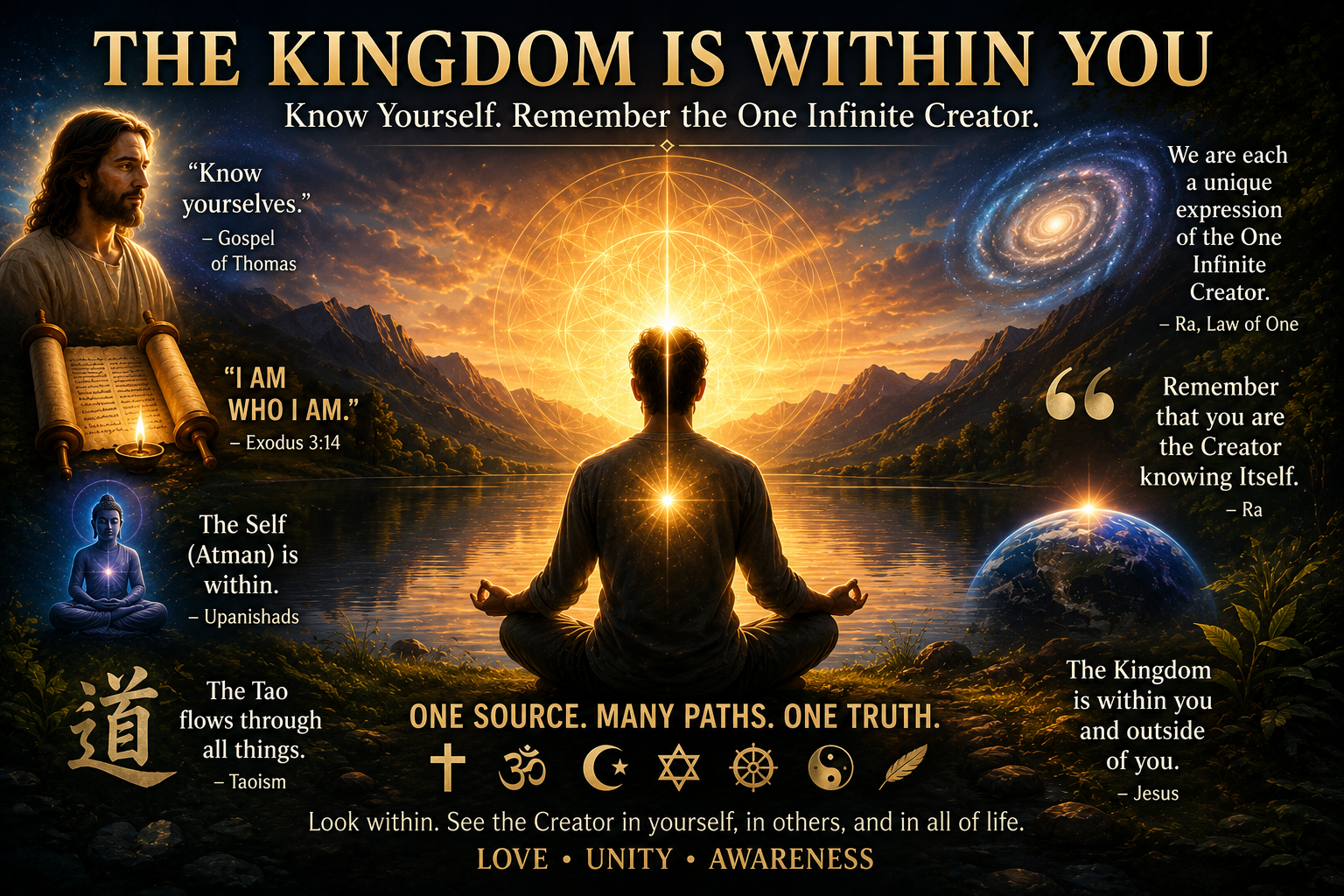
How Can We Know Ourselves?
One of the most profound instructions attributed to Jesus is found in the Gospel of Thomas:
“Know yourselves.”
At first glance, the instruction seems simple. But what does it actually mean?
Most of us spend our lives getting to know our careers, families, hobbies, opinions, and the world around us. We accumulate knowledge, experiences, and possessions, yet many of us rarely stop to ask the deeper question:
Who am I?
When Moses encountered the burning bush, he asked God His name. God answered:
“I AM WHO I AM.” (Exodus 3:14)
This is one of the most mysterious statements in all of Scripture. God did not give Moses a conventional name. Instead, He revealed Himself as pure Being—“I AM.”
Perhaps there is a lesson here for all of us.
Before we say:
“I am a father.”
“I am a mother.”
“I am a teacher.”
“I am successful.”
“I am afraid.”
There is simply…
I AM.
Everything we place after those two words describes a temporary condition or identity.
At first, we naturally identify ourselves with the body.
“I am this face.”
“I am this age.”
“I am this gender.”
Then we identify with the mind.
“I am my thoughts.”
“I am my memories.”
“I am my beliefs.”
“I am my emotions.”
Yet all of these change throughout our lives.
Your body is not the same as it was ten years ago.
Your beliefs have evolved.
Your emotions come and go.
Even your personality changes over time.
If everything you identify with is constantly changing, then who is the one who is aware of all those changes?
Every great spiritual tradition invites us to investigate that question.
When you sit quietly in meditation, when you become still, or when you simply observe your thoughts without becoming caught up in them, something remarkable becomes apparent.
There is an awareness behind the thoughts.
There is a silent observer behind every experience.
Thoughts arise.
Emotions arise.
Sensations arise.
They all pass away.
But the awareness that witnesses them remains.
Christian mystics spoke of discovering the indwelling presence of God.
The Upanishads called it Atman, the deepest Self.
Taoism points toward the silent awareness that lives in harmony with the Tao.
The Law of One describes our deepest nature as a mind/body/spirit complex whose true identity is a unique expression of the One Infinite Creator.
Knowing yourself, then, is not merely understanding your personality or your psychology.
It is recognizing that beneath every role you play and every identity you carry is an unchanging presence—the deepest essence of your being.
The journey inward is not about becoming someone new.
It is about removing the layers of conditioning, fear, false identity, and separation until what has always been there becomes unmistakably clear.
Perhaps this is why Jesus never told people to create the Kingdom.
He taught that it is already here.
It is not something to acquire.
It is something to awaken to.
The Kingdom Is Within You
Every ancient wisdom tradition teaches that there is something divine at the center of every human being. Jesus continually directs our attention inward—not toward external authority, but toward the deepest part of ourselves where the sacred already dwells.
He says:
“Know yourselves.”
— Gospel of Thomas
“The lamp of the body is the eye.”
— Matthew 6:22
“Seek and you shall find.”
— Matthew 7:7
Rather than teaching that salvation depends solely upon institutions, rituals, or religious authorities, Jesus repeatedly points to an inner awakening. His message invites us to discover the Kingdom of God not as something distant, but as a living reality already present within us.
This perspective aligns remarkably well with the teachings of the Law of One.
Ra explains that every conscious being is literally a unique expression of the One Infinite Creator. Our deepest identity is not the personality we have developed throughout this lifetime. It is not our name, occupation, beliefs, successes, or failures.
At our core, we are consciousness itself.
We are the soul.
We are the divine spark through which the Creator experiences creation.
According to Ra, the purpose of the spiritual journey is not to become something we are not, but to remember what we have always been beneath the veil of separation. We temporarily forget our unity with the Creator so that we may freely choose our path of love, service, and growth. Spiritual awakening is the gradual lifting of that veil.
When Jesus says,
“Know yourselves,”
he is inviting us to look beyond the temporary identity of the ego and discover our eternal nature.
The Law of One expresses this same realization in different language.
Ra might summarize it this way:
“Remember that you are the Creator knowing Itself.”
This is not a statement of personal superiority or ego.
It is an invitation to humility.
The same Infinite Creator that lives within you also lives within every other-self and throughout the entire universe.
The Kingdom within is therefore the awakening to this living truth: beneath all appearances, we are expressions of one Infinite Source, learning, growing, and discovering ourselves through the experience of life.
The Kingdom Is Consciousness
What if the Kingdom is not a place at all?
What if it is a state of consciousness?
Imagine standing before a mirror.
Most people immediately notice wrinkles, gray hair, imperfections, or appearance.
Jesus invites us to look deeper.
Ra invites us to look deeper.
Beyond the body…
Beyond the personality…
Beyond the thinking mind…
There is awareness itself.
The silent observer.
The witness.
The part of you that has watched every stage of your life.
That awareness has remained present while everything else has changed.
Many spiritual traditions regard that deeper awareness as our point of contact with the divine.
When Moses heard “I AM,” perhaps he was hearing more than a name.
Perhaps he was hearing the eternal reality of Being itself—the same divine presence that quietly exists beneath every human identity.
The Veil Begins to Lift
As we begin to recognize the Creator within ourselves, something remarkable happens.
We naturally begin to recognize that same presence in others.
Judgment softens.
Compassion grows.
Fear loses some of its hold.
Service becomes more natural.
This echoes Jesus’ commandment to love your neighbor and Ra’s teaching of service to others.
If the same divine essence lives in every person, then loving another is not merely an ethical duty.
It is the natural response to recognizing yourself in another-self.
The veil of separation begins to dissolve.
What once appeared to be “me” and “them” gradually becomes an awareness of one Life expressing itself through many forms.
The Living Kingdom
Perhaps Jesus was saying that the Kingdom is not waiting for us after death.
It is available now.
It is discovered in silence.
In compassion.
In forgiveness.
In self-knowledge.
In recognizing the sacred in ourselves and in every other-self.
The Kingdom is not hidden because God is absent.
It seems hidden because we have forgotten where to look.
The invitation of Jesus, the Law of One, the Upanishads, Taoism, Hermetic philosophy, and many other wisdom traditions is remarkably similar.
Turn inward—not to worship the ego, but to discover the deeper Self that participates in the One Infinite Creator.
Then return to the world with new eyes.
See the Creator in yourself.
See the Creator in every other-self.
See the Creator in all of creation.
Perhaps this is why Jesus could say:
“The Kingdom is within you and outside of you.”
The Creator is not merely beyond the universe.
The Creator is the very Life expressing itself through you, around you, and as the ground of all existence.
The Kingdom is not somewhere else.
It is the awakening to the One Infinite Creator—within you, within every other-self, and throughout all that is.

Leave a Reply