January 21, 1981
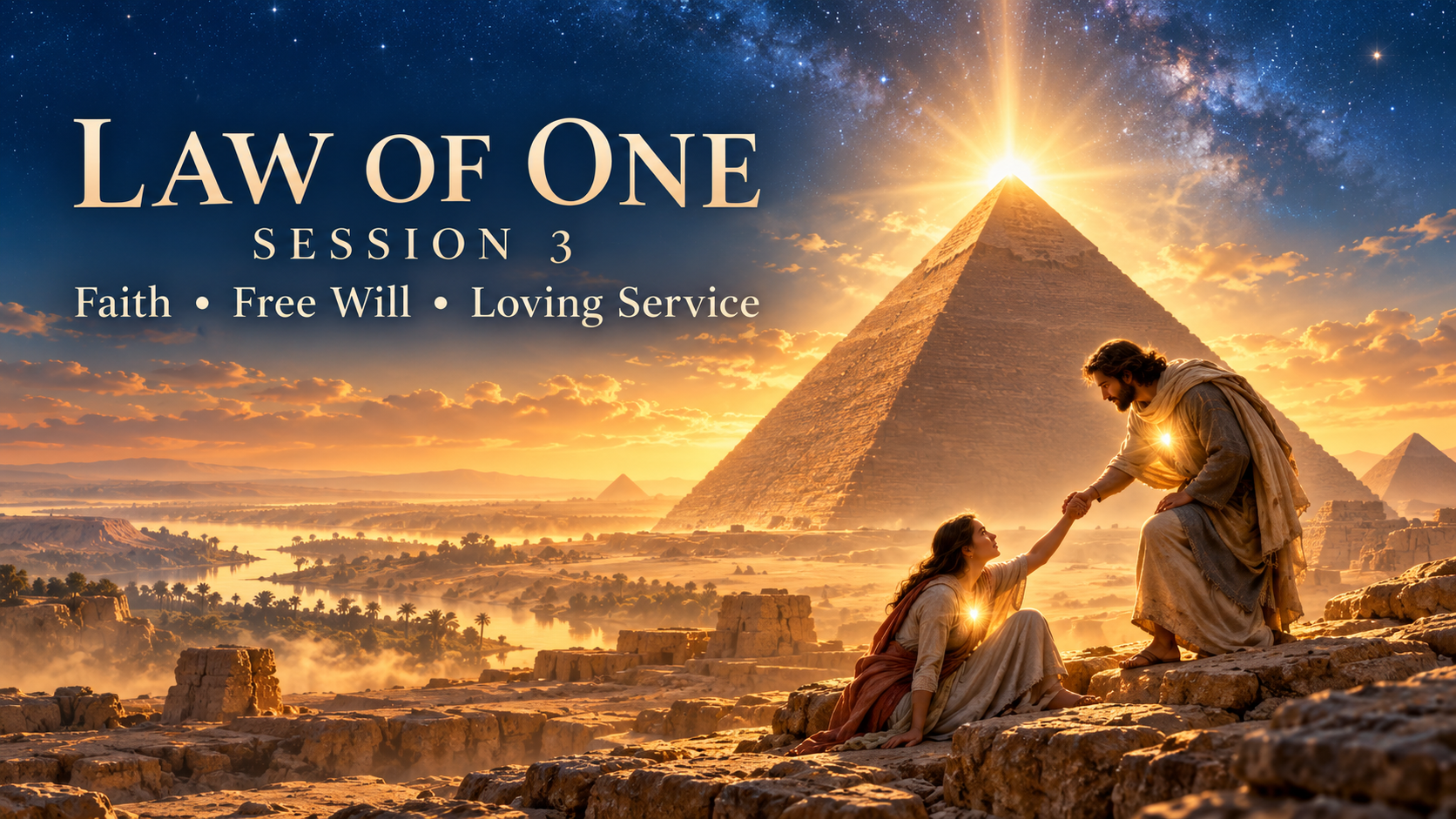
Session 3 moves from questions about the Great Pyramid into a deeper spiritual inquiry: What happens when we recognize ourselves—and everything around us—as expressions of one Creator?
Within Ra’s teaching, the answer involves faith, respect for free will, and the patient preparation of the mind, body, and spirit for service. The pyramid provides the setting, but inner transformation supplies the central message.
1. The intention to serve comes first
The session begins with adjustments to the Bible, candle, and incense surrounding the channel. Ra describes these objects as supporting the instrument’s physical, mental, and emotional balance.
Their meaning is personal to the instrument: familiar spiritual symbols help create an atmosphere of peace. Yet Ra places particular emphasis on the participants’ desire to serve others.
A practical reflection follows: Before seeking a spiritual experience, examine the intention you bring to it. Are you seeking understanding, greater compassion, or recognition and power?
2. Creation is alive with intelligence
Asked how the pyramid’s stones were moved, Ra describes intelligence within matter itself. In this account, the Creator inhabits even rock, and contact with that underlying intelligence makes extraordinary actions possible.
These are claims within the channeling’s spiritual framework; the transcript does not establish them as archaeological or physical findings.
As a contemplative teaching, the passage invites us to approach existence with reverence. If all things participate in one creation, even what seems ordinary deserves attention and care.
3. Faith and intelligent infinity
The questioner connects Ra’s explanation to Jesus’ teaching about faith moving mountains. Ra agrees that faith and “intelligent infinity” point toward a corresponding spiritual reality.
An interpretation of this passage is that faith involves a deeper alignment with the unity of existence. Intellectual knowledge alone does not amount to living that unity.
Knowing the words of a teaching and becoming an expression of it are different stages of the journey.
4. Unity allows imperfect beings to work together
Ra distinguishes an individual’s spiritual capacity from that of a unified “social memory complex.” Within this account, a collective can accomplish extraordinary things even while its members retain individual imperfections.
The human application is encouraging: we can contribute to meaningful shared work while still learning. Cooperation, sincerity, and a common purpose matter.
Ra also acknowledges continuing to seek. Even the teacher presented in this material has further to grow.
5. Free will protects the seeker
Ra says the pyramid was made to appear constructed from separate blocks to preserve uncertainty and avoid being worshiped as its miraculous builder.
This introduces the Law of Confusion, also called the Law of Free Will. The spiritual lesson is that assistance should leave room for people to discover, question, and choose.
Applied to everyday life, service respects another person’s freedom. Guidance becomes more generous when it does not demand agreement.
6. Inner preparation precedes spiritual service
Ra connects healing with initiation: the person serving as a channel must undergo preparation. The sequence begins with the mind, then proceeds to understanding the body.
The session’s account of sensory withdrawal symbolizes a transition in which an old way of experiencing life gives way to another. A gentle contemporary reflection is to make time for quiet, honest self-observation and awareness of the body.
“Spiritual growth finds its expression in service. As Jesus taught, greatness begins with becoming a servant—allowing what we have learned to become love in action.”
“And whosoever will be chief among you, let him be your servant: Even as the Son of man came not to be ministered unto, but to minister.”
— Jesus, Matthew 20:27–28 (KJV)
Session 3’s central invitation is to become more capable of loving service through self-knowledge, faith, and respect for freedom.
For reflection today: Where can I offer care without trying to control the outcome—and what within me needs greater understanding before I do?
Leave a Reply