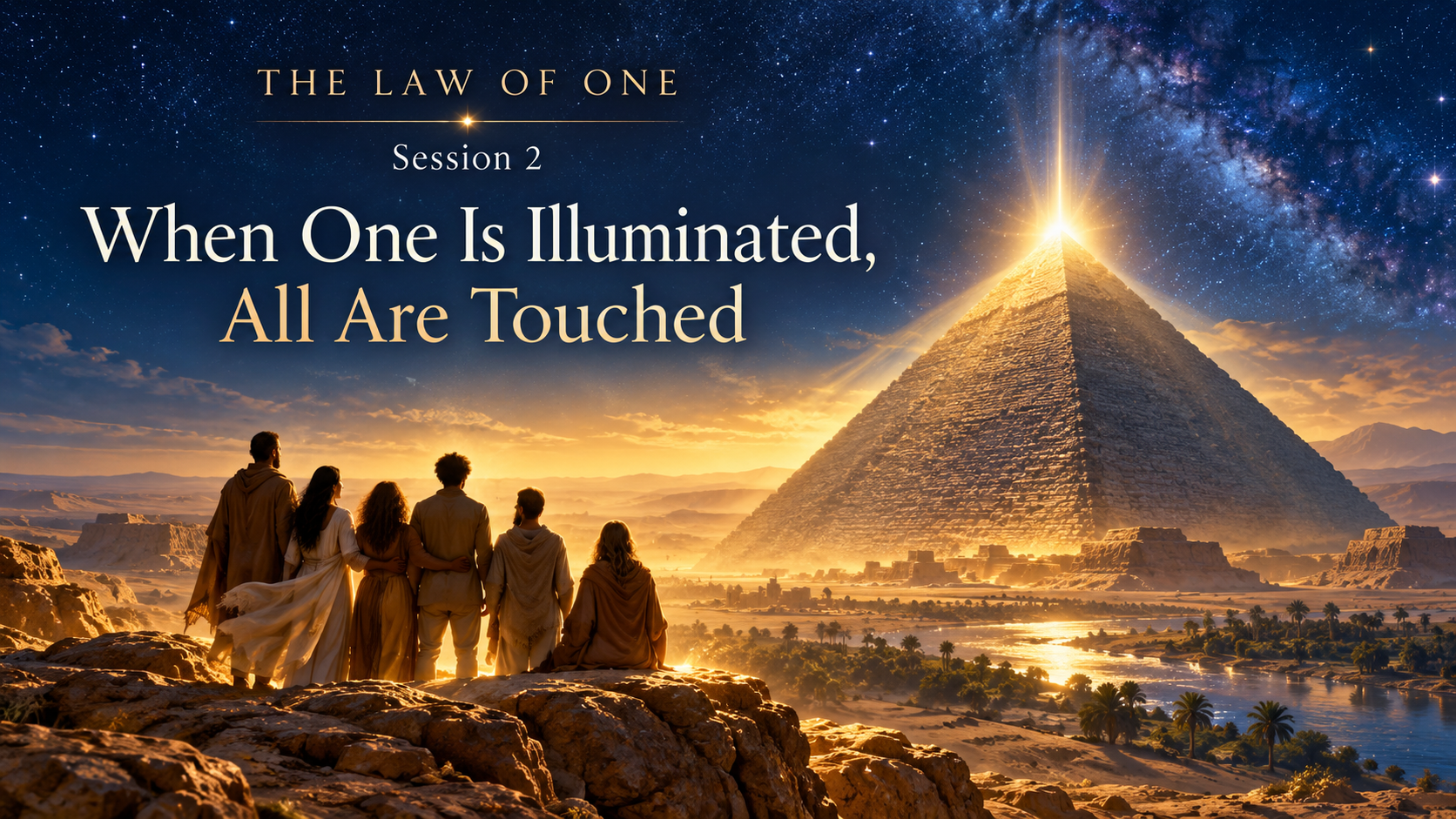
January 20, 1981 — An inspirational reflection on the Ra Material
Session 1 introduced the possibility that all existence shares one divine source. Session 2 brings that vision into the work of teaching, healing, and serving. Its invitation is to consider how our spiritual understanding becomes visible in the way we treat others.
Ra’s accounts of ancient civilizations, pyramids, and subtle energies belong to the session’s channeled narrative. The reflections below explore the meaning of that narrative while keeping its central message in view: spiritual gifts find their purpose in loving service.
The One speaking to the One
When asked whether the communications could become a book, Ra describes the contact as communication “from the One to the One.” Beneath the apparent separation between messenger, questioner, and reader lies a shared spiritual identity.
Ra then asks:
“If one is illuminated, are not all illuminated?” — 2.1
This gives the act of sharing a deeper significance. We do not need to reach an enormous audience for our work to matter. A conversation that brings understanding, a kindness that restores hope, or an article that helps someone feel less alone can become a meaningful contribution to the whole.
Ra also suggests that preparing the material for others helps clarify the understanding of those preparing it. Teaching and learning belong together. As we put insight into words, we discover where our own understanding is clear and where it still needs patience.
Keep the teaching at the center
Before recounting its claimed involvement with ancient cultures, Ra asks the group to place limited emphasis on history. Its responsibility, it says, is philosophical.
This is an important guide for reading the session. Ancient mysteries may awaken curiosity, but the lasting question is how an understanding of unity changes our lives.
Do we become more compassionate? More willing to listen? More responsible with the influence we have?
Spiritual knowledge becomes fruitful when it shapes our conduct.
When gifts become instruments of power
In Ra’s account, Confederation visitors came to two cultures approximately eleven thousand years earlier, hoping to assist through healing technologies. Ra associates its own work with Egypt and describes a separate group working in South America.
The intention was service. Yet the technology became largely reserved for people with power. What had been offered for the benefit of many became a privilege of the few.
The spiritual lesson reaches beyond this narrative: good intentions require discernment. Knowledge, authority, and spiritual practices can be used to help people grow, or to increase their dependence on those who possess them.
Ra describes withdrawing from direct contact while remaining concerned about the consequences of its intervention. Here, responsibility includes acknowledging when help has produced unintended effects.
For the reader, this invites a humble question: does my way of helping respect another person’s freedom?
Akhenaten and the limits of a decree
Ra identifies the Egyptian pharaoh Akhenaten as a Wanderer receptive to its message. It describes his turn toward Aten, the sun disc, as an approximation of unity rather than a complete expression of the Law of One.
According to the session, few inwardly embraced his conviction. Priests offered outward agreement, while the people largely retained their beliefs. Ra’s narrative later refers to Muhammad as bringing a more intelligible understanding of relationships among mind, body, and spirit.
An inspiring reflection emerges from Akhenaten’s story: an inward awakening cannot be accomplished simply by declaring what others must believe.
A teaching takes root through sincere seeking. Each person must have room to encounter its meaning for themselves.
The healer’s inner preparation
In discussing crystals, Ra places great emphasis on the person using them. Within its framework, the crystal’s function depends on the healer’s purification, alignment, and capacity to channel love and light.
The session describes different relationships among spirit, mind, and body, and presents healing as a process of balancing these relationships. It also emphasizes perseverance through initiation.
Its broader spiritual lesson is that an external tool does not remove the need for inner work.
We may gather books, symbols, and practices, yet still need to examine our motives, cultivate patience, and become more honest with ourselves. The quality of our presence matters to the service we offer.
Initiation in the service of healing
Ra assigns two purposes to the pyramids: initiation and healing. In its account, initiates were prepared to serve people and assist the planet through structures that balanced incoming energies.
Ra also describes stones as alive, extending the session’s vision of consciousness into the material world.
Read contemplatively, these ideas encourage reverence for creation and a purposeful understanding of spiritual development. Inner growth prepares us to participate more lovingly in life.
The question becomes: what can my awakening contribute to the well-being of others?
Care for the person who serves
As the channel becomes fatigued, the session turns toward her comfort. Ra recommends a particular ritual and arrangement of water, a familiar Bible opened to John 1, incense, a candle, clothing, and bodily positioning.
These instructions are specific to the channeling group and the individual serving as its instrument. Their wider significance is the attention given to her sensitivity and exhaustion.
Service includes care for the one who serves. Rest, comfort, and a supportive environment have a place in spiritual work.
The prescribed dialogue also calls Ra a humble messenger. The messenger points toward unity; the group’s seeking remains centered on the Law of One.
Carrying the message into daily life
Session 2 brings together a compelling set of themes: shared illumination, reciprocal learning, responsibility, freedom, inner preparation, and compassionate care.
Its central invitation can be expressed simply:
Let your understanding of unity become a way of serving.
Share what has helped you. Allow others their own path. Examine how you use influence. Care for the people who give their energy to others, including yourself.
You do not need to illuminate the whole world at once. Begin with the life before you.
From the Bible — Matthew 5:16 (KJV)
“Let your light so shine before men, that they may see your good works, and glorify your Father which is in heaven.” Bible Gateway
This fits Ra’s question in Session 2: “If one is illuminated, are not all illuminated?” Jesus connects light with action: what awakens within us becomes a blessing to others through kindness, compassion, and service.
From the Gospel of Thomas — Saying 77, an excerpt (Thomas O. Lambdin translation)
“Split a piece of wood, and I am there. Lift up the stone, and you will find me there.” gnosis.org
This saying attributed to Jesus offers a spiritual parallel to Session 2’s description of a living creation—even its statement that “the stones are alive.” Read mystically, it invites us to recognize divine presence throughout the ordinary world. That is a connection between the teachings, rather than a claim that they mean exactly the same thing.
Together, they offer a beautiful reflection: Recognize the sacred presence around you, and let that recognition shine through the way you serve others.
A moment of reflection
Sit quietly and ask:
● What have I learned that I can share with kindness?
● Does my service help another person become freer?
● Where do I need greater balance before giving more?
Choose one small act of care, and carry it into your day.
Source: https://www.lawofone.info/s/2
Leave a Reply