January 28, 1981
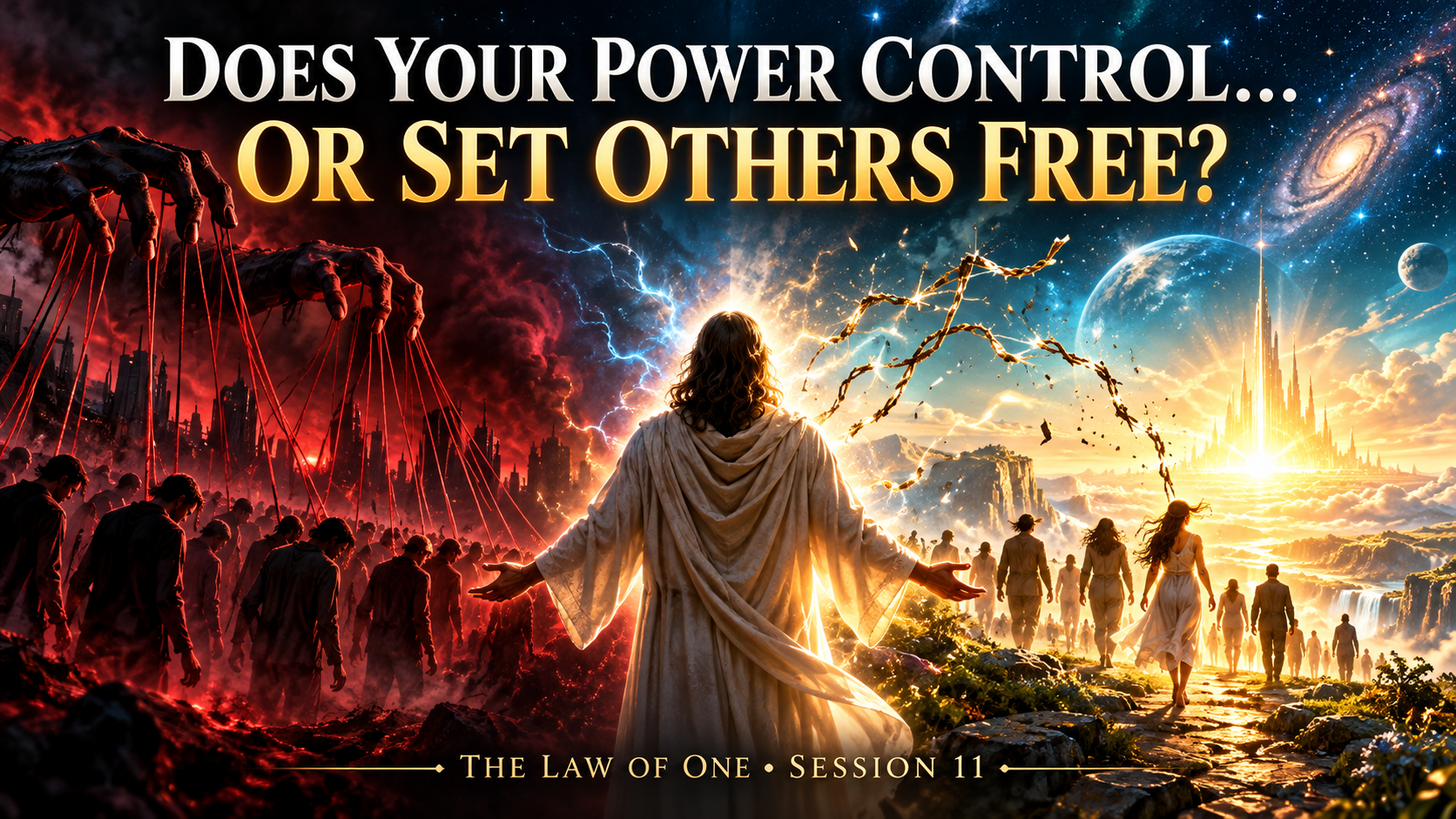
What makes an action spiritual? Is it the knowledge behind it, the power it demonstrates, or the intention with which it is offered?
Session 11 of the Ra Material explores these questions through teachings about spiritual polarity, collective consciousness, the use of technology, and the difference between liberation and domination. Its accounts of other worlds and spiritual influences belong to the channeling’s metaphysical framework. The invitation for the reader is personal and practical: examine what your choices cultivate in yourself and in others.
The central message is that knowledge and power take their direction from the purpose they serve. We can use our abilities to strengthen separation and control, or to create greater freedom, understanding, and opportunities to love.
1. Our direction grows through our choices
The session returns to Maldek, the world that Ra previously described as destroyed through warfare. Asked what might have happened without that destruction, Ra describes a possible mixed outcome: some beings progressing along the positive path, some along the negative path, and most continuing their learning in third density. Ra also acknowledges the uncertainty of an outcome that never occurred. (11.3)
Within this teaching, sharing a planet does not mean everyone has chosen the same spiritual direction. Each person develops through their own intentions and responses.
For the reader, this shifts attention toward the choices available today. We cannot make another person become compassionate, but we can practice compassion. We cannot resolve every conflict, but we can notice when our own words deepen hostility or invite understanding.
Spiritual direction takes shape in the repeated decisions of ordinary life.
2. Spiritual ability carries a responsibility
Ra describes a small number of beings as having advanced along the path of service to self through intense discipline and access to deeper levels of consciousness. The session names Taras Bulba, Genghis Khan, and Rasputin in this account. (11.8–11.13)
The underlying teaching is significant: unusual abilities, concentrated will, and metaphysical knowledge can accompany a desire to dominate.
A useful question follows whenever we encounter a compelling teacher or extraordinary claim: What does this teaching encourage us to become? Does it deepen compassion, responsibility, and respect for others’ freedom? Does it encourage dependence, superiority, or obedience to someone else’s power?
The same examination applies inwardly. Every ability we develop gives us another opportunity to consider whom it serves.
3. Unity includes responsibility for how we treat others
One of the session’s most challenging ideas is Ra’s assertion that all beings serve the Creator, including those pursuing service to self. Within the Law of One, every being remains part of the same creation, even while acting from a profound sense of separation. (11.14–11.15, 11.31)
This requires careful interpretation. Recognizing a shared source does not make cruelty harmless or remove responsibility for suffering. The session itself describes the negative orientation through manipulation and the use of others for personal power.
For someone choosing service to others, unity can inspire compassion alongside clear boundaries. We can recognize another person’s humanity while refusing to participate in exploitation. We can seek understanding while protecting those who are vulnerable.
Love becomes practical through the way we respond to actual people and actual harm.
4. Discernment begins with the fruits of actions
Asked to identify contemporary recipients of negative influence, Ra declines and directs the questioner to consider the results of people’s actions. (11.18–11.21)
This offers one of the session’s most useful practices: observe what a person, teaching, or institution produces over time.
- Does it help people think and choose for themselves?
- Does it welcome sincere questions?
- Does it treat vulnerable people with dignity?
- Does it concentrate power through fear, dependence, or manipulation?
These questions can guide discernment without requiring us to identify anyone’s unseen spiritual affiliations. The behavior before us already gives us something meaningful to examine.
The teaching also invites self-reflection. When we offer guidance, do we leave the other person free? When someone disagrees, can we remain respectful? Service becomes clearer when we release the need to control its recipient.
5. Shared seeking opens the possibility of deeper understanding
Ra defines a social memory complex as a society whose members share an orientation or seeking and gain access to collective memories previously unavailable to individuals. In this description, shared understanding helps the group pursue its chosen direction with less distortion. (11.17)
Shared orientation alone does not establish benevolence; the session also describes negatively oriented groups. The purpose of the unity matters.
For everyday life, we can draw a modest parallel: communities learn more effectively when people contribute experience, listen carefully, and pursue a shared purpose. A family, friendship, or study group can become a place where understanding grows through honest participation.
Each of us can help create that atmosphere by making it easier for others to speak truthfully and be heard.
6. Technology expresses the intentions of its users
The discussion turns to scientific knowledge and its potential uses. Ra describes information intended for peaceful progress being redirected toward destructive purposes, including in the development of nuclear technology. These explanations of outside spiritual influence are part of Ra’s account. (11.21–11.24)
The practical issue is familiar: an invention effect depends on how people develop, distribute, and use it.
Knowledge can relieve suffering, expand access, and reduce exhausting labor. It can also support surveillance, coercion, and destruction. Greater capability brings a greater need to examine purpose and consequences.
The spiritual question becomes: Who benefits, who carries the burden, and how much freedom does this use of knowledge create?
7. Tesla’s story connects practical service with spiritual opportunity
Ra portrays Nikola Tesla as strongly oriented toward helping humanity and describes his intended work as making energy available for lighting and power. The transcript explicitly clarifies that freeing people from darkness refers here to literal illumination. (11.25–11.27)
Ra then describes a further possibility: reducing the financial burden of energy could give people more leisure and greater opportunity to seek inwardly. The session similarly attributes waves of Wanderers associated with the Industrial Revolution to an intention to ease the demands of daily labor. (11.28–11.29)
Within this account, practical help can open space for spiritual discovery. Someone consumed by the effort to survive may have little time or energy for contemplation.
We can apply this principle through ordinary service. A meal, a repair, help with an overwhelming task, or time spent caring for someone can give another person room to breathe. We cannot determine what they will do with that freedom. We can help make it available.
Bringing Session 11 into daily life
The session begins and ends with attention to the instrument’s comfort and the group’s care for the conditions of the contact. Alongside its expansive metaphysical themes, it keeps returning to the needs of the person present. (11.2, 11.30)
That is a fitting place to practice its message. Consider one relationship in which you can listen more freely, one ability you can use generously, or one burden you can help someone carry. Examine your own influence with the same honesty you bring to the influence of others.
Session 11 invites us to recognize that service can create freedom: freedom from unnecessary hardship, freedom to question, and freedom to discover an inward relationship with the Creator. In choosing to ease a burden without taking possession of another person’s path, we give love a concrete expression. We offer another being room to grow—and grow through the offering ourselves.
Source: The Law of One, Session 11, January 28, 1981, as supplied in the attached transcript. Section references identify the passages discussed. Practical applications are interpretations offered for reflection. Home of The Law of One material, L/L Research
Leave a Reply