January 27, 1981 — From the story of Maldek to four simple exercises for awakening
What if spiritual growth begins with the moment we are already living?
Session 10 of the Ra material moves from accounts of lost civilizations and planetary destruction to a teaching that can be practiced in any ordinary day: seek love, recognize the Creator, and bring awareness to how we live.
The session’s distant histories belong to Ra’s channeled account. Its practical invitation is immediate. Whatever our origins, we have the opportunity to choose how we meet one another now.
Maldek: When Power Outruns Understanding
Ra describes Maldek as a world whose people developed powerful technology and ultimately destroyed their planet through war. One of the most searching details is that many believed their actions served others, even as their civilization moved toward domination and destruction. (10.1)
This raises a question that reaches beyond the story: Do our actions express the love we believe motivates them?
Good intentions need honest examination. We can justify control as protection, hostility as righteousness, or personal ambition as service. The lesson is to look at what our choices actually produce, including their effects on those who disagree with us.
In Ra’s telling, the destruction left Maldek’s people caught in a collective knot of fear. Assistance eventually reached them, allowing consciousness, healing, and reflection to resume. They then chose a restrictive incarnation experience on Earth as a means of addressing the consequences of their actions. Ra distinguishes their third-density consciousness from the second-density bodies they inhabited, and says many eventually moved forward into further third-density lives. (10.1–10.5)
The spiritual theme is the possibility of restoration after profound error. Healing allows responsibility to become a path forward.
Earth: Many Origins, a Shared Lesson
Ra says Earth’s population draws from many places in creation, including beings repeating a cycle of learning. This diversity of origins is offered as one explanation for humanity’s difficulty finding a unified direction. (10.6)
Within this worldview, people arrive with different tendencies and unfinished lessons. A practical response is patience: another person’s struggle may be largely invisible to us.
Unity does not require identical experiences or beliefs. It asks us to recognize a shared source amid our differences.
Free Will and the Direction of the Heart
Asked whether Earth could suffer a fate like Maldek’s, Ra avoids predicting the future. The response places emphasis on the orientation of mind and spirit, and on the responsibility of free choice. (10.8)
Tools magnify the purposes we bring to them. Knowledge and power therefore call for an equal commitment to self-examination.
We can bring that examination into daily life: Am I trying to understand, or to control? Does this choice respect another person’s freedom? What would service look like here?
These questions turn a distant planetary warning into a personal practice.
Healing, Review, and Further Learning
Ra describes the transition between cycles as a process involving healing, the distillation of experience, and the selection of an environment appropriate to further development. (10.9–10.10)
The emphasis is on what consciousness has learned and what it still needs to learn. Experience becomes meaningful through its integration.
For a reader reflecting on this teaching, a useful question is: What am I learning from what I have lived? A difficult experience may gradually become a source of understanding, compassion, or wiser action.
Conscious Attention Deepens Spiritual Growth
Ra affirms that becoming aware of spiritual learning can accelerate growth. The session then connects that growth with accepting responsibility for the present moments available to us. (10.11–10.12)
This can be understood as responsibility for our participation in life: the attention we give, the responses we choose, and our willingness to recognize when we have caused harm.
We will not respond perfectly every time. We can notice, make amends, and choose again. Ordinary encounters become opportunities to practice what we believe.
Ra also describes sincere collective seeking as mutually empowering. The language of the call emphasizes how individual intention joins with the seeking of others. (10.13)
Four Exercises for Living the Law of One
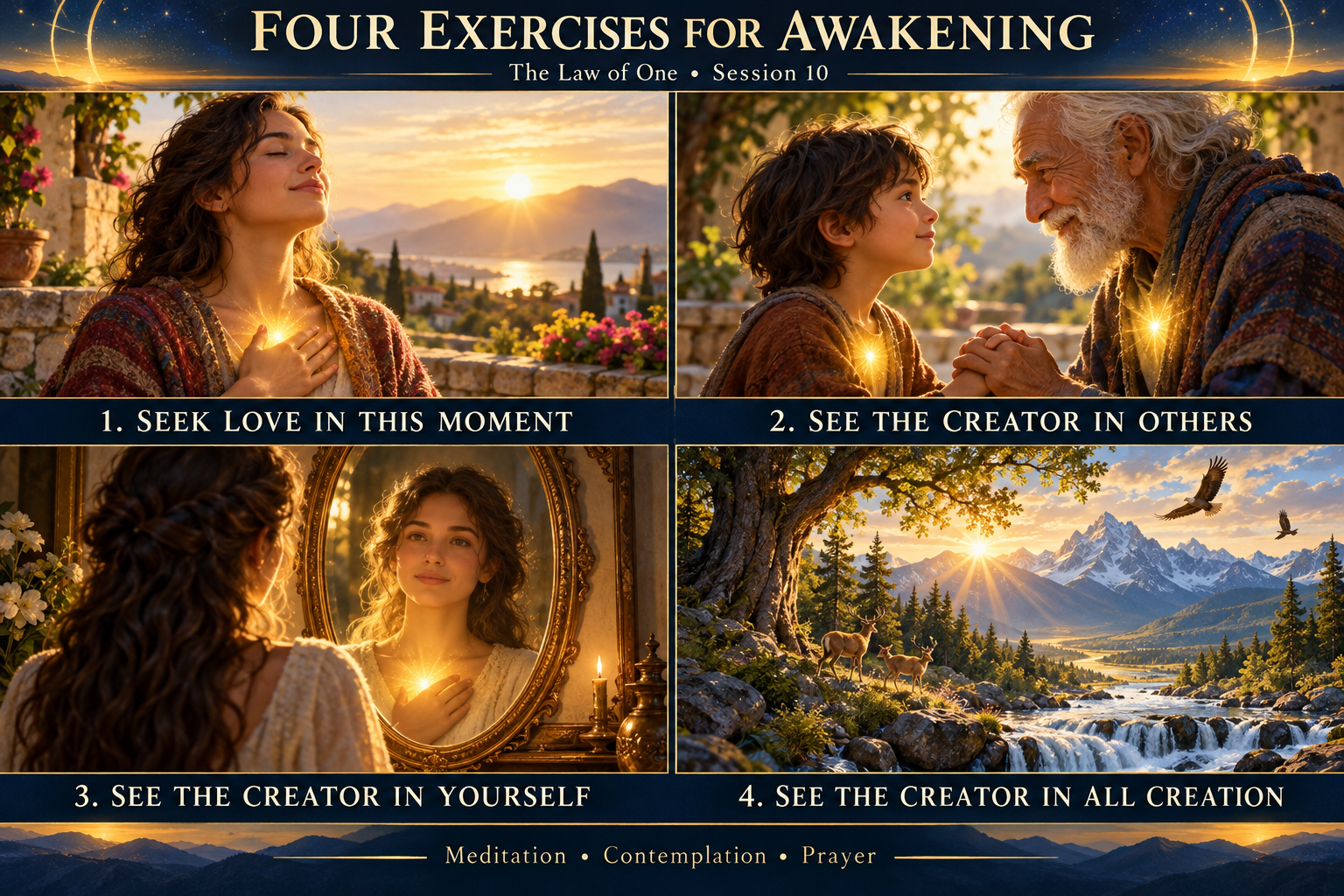
The heart of Session 10 is a set of four exercises. Their simplicity makes them easy to remember; their depth unfolds through practice. (10.14)
1. Seek Love in the Moment
“The moment contains love.”
Ra presents consciously seeking that love as the central exercise of this density.
Love may appear as appreciation, patience, courage, forgiveness, or a clear boundary expressed without cruelty. In a painful situation, seeking love can mean offering protection or asking for help. We need not call harmful behavior loving to choose a loving response.
Each sincere return to this practice strengthens the intention to live by it. Ra explicitly allows for imperfection in the seeking; sincerity matters more than flawless execution.
2. See the Creator in Another Person
The second exercise asks us to recognize the Creator when looking at another being.
Try it with someone familiar, then with someone difficult to understand. Their behavior may still require discernment and boundaries. The practice is to remember that their being has a depth beyond the behavior before us.
3. See the Creator in Yourself
The third exercise brings the same recognition to the mirror.
Compassion includes ourselves. We can acknowledge our mistakes and limitations while recognizing that we, too, belong to the unity we seek to honor.
This invites humility and self-respect together: a willingness to learn without treating ourselves as beyond love.
4. See the Creator in the World Around You
The fourth exercise extends this awareness to creation itself.
A tree, an animal, the sky, or water moving across the earth can become an invitation to attention. Familiar surroundings acquire depth when we approach them as expressions of a shared source.
The practice can begin during a walk, in a garden, or in a quiet moment at home.
Let the Teaching Take Root
Ra identifies meditation, contemplation, or prayer as the foundation for these exercises. Quiet reflection helps understanding reach beneath the surface of thought and influence how we live. (10.14)
A simple daily rhythm is enough to begin: sit quietly, choose one exercise, and return to it during the day. In the evening, reflect gently on where love was easy to recognize and where it was difficult.
The difficult moments can guide tomorrow’s practice.
Lemuria and Atlantis: Spiritual Maturity and the Use of Power
Near the close, Ra distinguishes Lemuria, or Mu, from Atlantis. In this account, Mu was spiritually advanced despite its relatively simple material development, and was lost through tectonic changes rather than its people’s actions. Atlantis developed considerable technological and energetic abilities, then turned toward manipulation and destructive conflict. Ra also recounts surviving groups and migrations from both civilizations. (10.15)
These are elements of the session’s spiritual narrative rather than established archaeological history. Their contrast carries a clear theme: technical accomplishment and spiritual maturity can develop unevenly.
Our abilities call for care in how we use them. The desire to shape the outer world benefits from a continuing willingness to examine the inner life.
The Main Message
Session 10 begins with worlds lost and ends by giving us something we can practice wherever we stand.
Seek love in this moment. Recognize the Creator in the person before you. Offer that recognition to yourself. Extend it to the living world.
A lifetime is made of present moments. Each one gives us another opportunity to bring understanding into action.
Session 10’s invitation to recognize the Creator in others, ourselves, and creation finds echoes in ancient spiritual teachings. In Matthew 25:40, Jesus identifies service to the least of his brethren with service to himself, making compassion an encounter with the sacred. In the Gospel of Thomas, Saying 77, Jesus describes his presence even in wood and beneath a stone—an image that resonates with Ra’s exercise of seeing the Creator throughout creation. The Bhagavad Gita 6:29 speaks of seeing the Self in all beings and all beings in the Self, while the Isha Upanishad, verses 6–7, connects this recognition of oneness with freedom from hatred and delusion. Read together, these passages offer a shared invitation: let spiritual understanding become a way of seeing, and let that vision bear fruit in the love we bring to everyday life.
Source: The Law of One, Session 10, January 27, 1981, supplied transcript. Read the session. Practical applications are reflections on the teaching. Home of The Law of One material, L/L Research
Leave a Reply