January 29, 1981
What if spiritual growth is less about how much we discover and more about how deeply we learn to love?
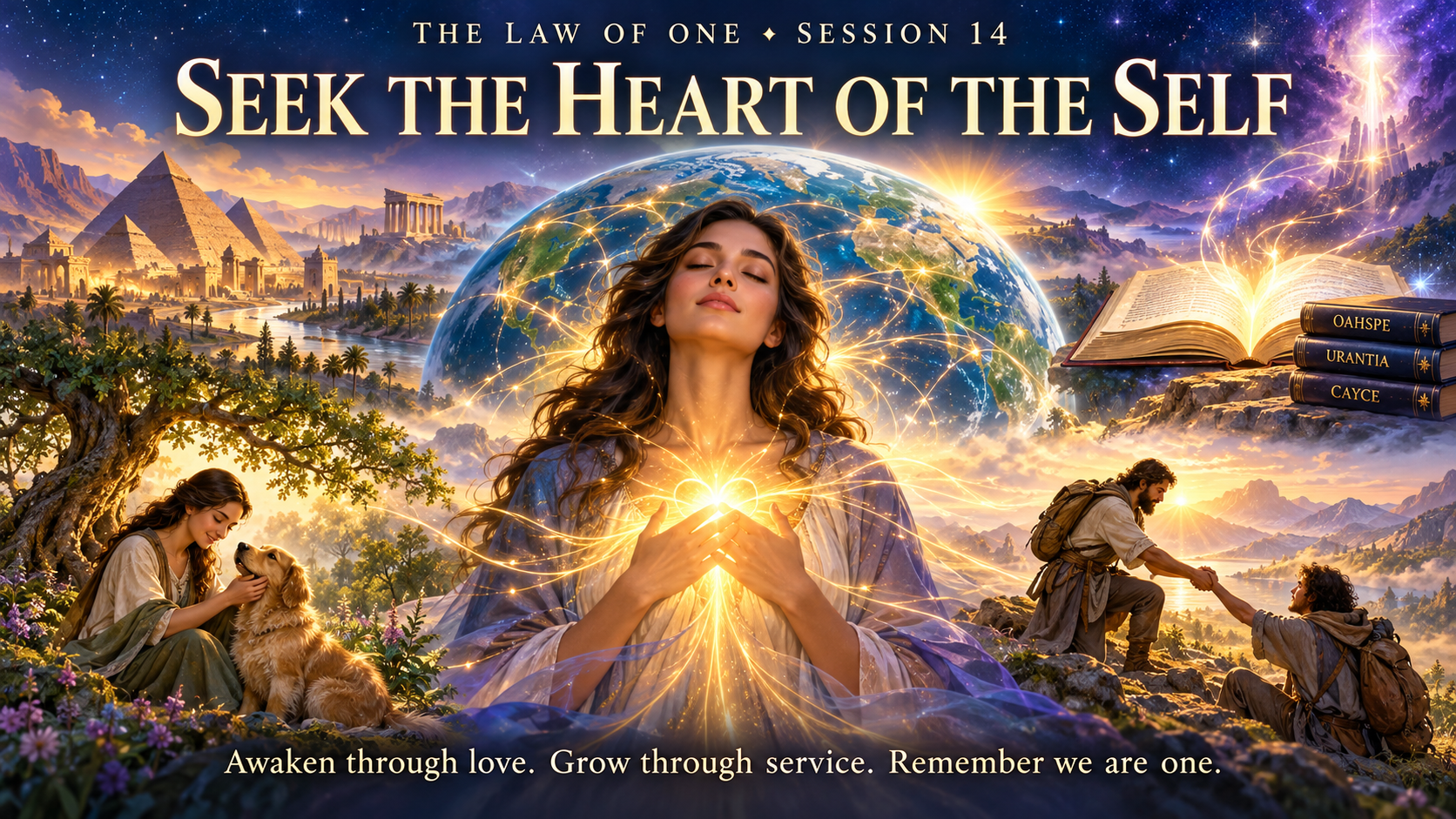
Session 14 moves through ancient civilizations, pyramids, spiritual evolution, and the origins of other spiritual writings. Yet its most personal teaching brings us back to something close and immediate: the heart of the self.
Within Ra’s account, humanity receives help because all life belongs to one creation. Service becomes an expression of that relationship. Another person’s suffering concerns us because, at the deepest level, we are connected.
The following explores the session as a spiritual teaching. Its accounts of ancient history, unseen beings, and planetary energies belong to the Ra material’s metaphysical framework rather than established historical or scientific findings.
Love and the awakening of self-awareness
The session begins with a familiar relationship: the bond between people and animals.
Ra explains that third-density beings can help second-density beings develop self-awareness through personal attention and love. Pets are the example given. Being recognized, named, and loved as an individual can, in this framework, encourage a being’s growing sense of its own identity.
Ra also includes religious practices that personify and offer love to aspects of nature. Without this investment from self-aware beings, Ra says, development still proceeds through the upward movement of creation, though more slowly.
The spiritual invitation is simple: our care matters. The way we treat an animal can become part of a relationship that nurtures both lives.
Humanity’s story within a larger journey
Ra describes the beginning of Earth’s third-density cycle approximately 75,000 years ago, including an influx of beings from Mars and changes to the bodily forms they would inhabit. Ra distinguishes these physical changes from the placement of the soul.
The session then recounts attempts to assist humanity: approximately 58,000 years ago with Mu, 13,000 years ago with Atlantis, and 11,000 years ago in Egypt, followed by further efforts involving South America and Egypt.
Ra clarifies that Ra’s own physical presence among humanity occurred only during the Egyptian visit. Other episodes involved other assisting beings.
Whatever a reader makes of this chronology, its role in the session is to present spiritual learning as a long process. Assistance is offered repeatedly, and those receiving it remain capable of misunderstanding or misusing it.
That offers a useful question for any seeker: How do we put an inspiring teaching into practice without turning it into a source of authority over others?
The pyramids and the opportunity to learn love
Ra distinguishes six balancing pyramids from fifty-two others intended for healing and initiation.
Within this account, balancing pyramids worked with a planetary energy web, while the other pyramids served individual healing and the training of healers. The balancing structures could also support individual initiation.
Ra connects these efforts with humanity’s shortened lifespan. More time within an incarnation would, in this explanation, give people a fuller opportunity to learn the ways of love.
The underlying purpose gives the teaching its meaning: additional years would offer additional opportunities to understand, reconcile, and serve.
For us, that becomes a question about the time already available. What are we doing with today’s opportunity to love?
Seek the heart of the self
When Don asks about completing George Van Tassel’s Integratron to extend life, Ra redirects the conversation toward inward seeking. In the context of the harvest discussed in 1981, Ra places the emphasis on the heart of the self and the being’s violet-ray expression.
In the material’s terminology, violet ray represents the overall expression of the mind, body, and spirit. The emphasis is on the state of the whole being.
A practical reading is that spiritual readiness reaches deeper than familiarity with spiritual ideas. It involves what we have become through our choices.
We can bring that inquiry into ordinary life:
- Where am I responding from fear or defensiveness?
- Can I recognize another person’s needs without trying to control them?
- What would a more loving response look like here?
- What part of myself needs honest attention and acceptance?
These questions are reflections inspired by the session, rather than exercises Ra explicitly prescribes in it.
Those who stayed to serve
Ra describes no harvest at the end of the first 25,000-year cycle. During the latter part of the second cycle, a small number became capable of advancing, yet remained to serve others.
Don asks whether these beings stayed in third density despite being ready for fourth density. Ra confirms this.
It is one of the session’s most moving teachings: growth can deepen the desire to help those still struggling.
We can recognize that pattern in everyday life. Someone who has endured grief sits patiently with another mourner. A person who has found greater peace offers steadiness to someone in turmoil. What has been learned becomes something to share.
Service does not require that we have finished learning. It asks us to offer what we can.
Why Ra serves: creation as one body
In explaining the motivation to help Earth, Ra compares creation to a single body. A wound in one part calls for the attention of the whole.
Ra also acknowledges responsibility for earlier teachings that were distorted and expresses a desire to help address those consequences.
These two motives belong together: compassion for suffering and responsibility for the effects of one’s actions.
Ra identifies as sixth density, seeking toward seventh, and describes service and the balancing of love and light as part of that continuing development. Within this teaching, learning continues even for those who assist others.
The person offering help is also growing through the encounter.
Inspiration, awakening, and discernment
Ra says assistance has often come through dreams and visions, with recipients unaware of the claimed source. The session also describes how difficult experiences can prompt someone to begin seeking.
This leaves room for an awakening that begins in an unexpected place. A person may start asking deeper questions after loss, disruption, or a change in what once seemed certain.
It does not establish that every dream is a message or that suffering must happen for someone’s benefit. Its hopeful implication is that seeking can begin wherever we find ourselves.
Discernment remains essential. When asked for a list of other Confederation books, Ra declines, explaining that such a list would influence future discernment.
For a reader, this invites an active relationship with spiritual writing. We can consider a teaching carefully and observe what grows from applying it.
Oahspe, The Urantia Book, and Edgar Cayce
Session 14 directly addresses three other bodies of spiritual material.
Ra attributes Oahspe to a Confederation social memory complex and describes its religious framework as both concealing and revealing teachings about unity. Ra says its names were created for their vibrational characteristics and places the emphasis on deeper lessons about love, light, and the work of many messengers.
That suggests reading Oahspe with attention to spiritual meaning, without assuming Ra has authenticated every narrative detail as literal history.
Ra attributes The Urantia Book to discarnate beings of Earth’s inner planes and says the material was not passed by the Council. This statement alone does not establish that the book is negative or without value.
For Edgar Cayce, Ra gives a different explanation: no entity was speaking through him. Instead, Ra describes Cayce as accessing what people call the Akashic Record or Hall of Records, identified here with Earth’s potential social memory complex.
These are Ra’s descriptions of the sources. Their inclusion also reinforces the importance of examining teachings individually.
“There are no mistakes”
The session closes when Don asks whether the group is accomplishing its work reasonably well.
Ra answers:
“The Law is One. There are no mistakes.” — 14.34
Read alongside Ra’s acknowledgment of distorted teachings and the effort to address them, these words need not erase responsibility. They can offer reassurance that imperfect efforts still belong within the journey of learning.
We can recognize a harmful choice, make amends, and grow. We can discover that an earlier understanding was incomplete and remain willing to learn.
Session 14 brings its wide-ranging discussion back to a deeply personal invitation: seek the heart of the self, attend to the suffering within reach, and let understanding become service.
The opportunity is already present—in the person beside us, the animal entrusted to our care, and the next choice we make.
Source: The Law of One, Session 14, January 29, 1981. Home of The Law of One material, L/L Research.
Leave a Reply