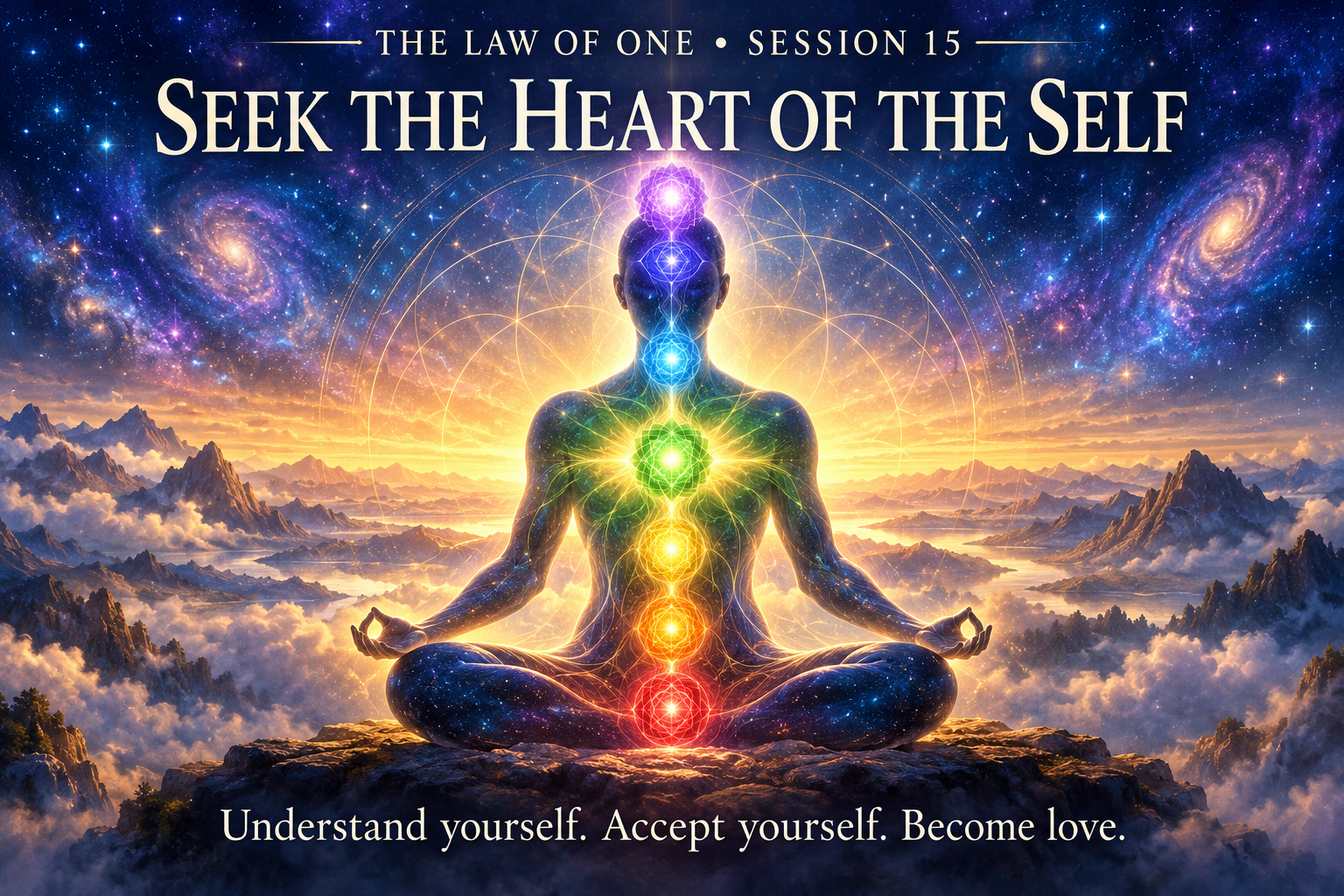
An inspirational exploration of the January 30, 1981 session
What is the greatest service we can offer? How do we find balance within ourselves? And what does it mean to discover the Creator in the life we are already living?
Session 15 brings these questions together through a central teaching: the spiritual journey unfolds as we understand, experience, and accept ourselves, deepen our connection with others, and turn toward the unity underlying existence. In Ra’s account, our ordinary lives provide the material for this discovery.
The Greatest Service Is the Offering of Yourself
When Don Elkins asks about the greatest service an individual can perform, Ra answers:
“The offering of self to Creator is the greatest service.” — 15.7
Ra then explains that many forms of service can grow from this offering. Some become healers, some teachers, and some workers. Their activities differ, but the underlying dedication can be the same.
This invites us to reconsider the value of our daily contributions. Listening patiently, doing honest work, caring for someone, or responding with kindness can become expressions of a life offered in service. We need not wait until we have an impressive spiritual role to begin.
The question becomes: How can I offer the person I am, with the abilities I have, in love today?
Balance and the Flow of Love
Ra describes existence as animated by one energy, expressed through terms such as love/light, light/love, and intelligent energy. Within this metaphysical framework, both the planet and the individual receive energy through interconnected fields and centers. Balance allows these centers to function fully; blockages distort the flow. — 15.9
As a practical reflection, this encourages attention to the whole of our lives. Our relationship with the body, our self-acceptance, our dealings with others, our compassion, and our communication all matter to spiritual growth.
An inspiring meditation can open a door. Daily experience shows us where greater understanding is still needed.
Understanding the Seven Energy Centers
In 15.12, Ra outlines the energy centers and the difficulties associated with their blockage. The descriptions below summarize that teaching; the questions are invitations for personal reflection.
| Energy center | Emphasis in Session 15 | A question for reflection |
|---|---|---|
| Red ray | Acceptance and understanding of the fundamental Earth or bodily energy. | Can I meet my embodied life with acceptance? |
| Orange ray | Personal and emotional experience, especially understanding and accepting oneself. | What part of myself do I struggle to accept? |
| Yellow ray | Social relationships, including patterns involving power and manipulation. | Where do I try to control others or secure my place through power? |
| Green ray | Universal love and compassion; a springboard toward infinite intelligence. | Can I extend compassion beyond those who are easy to love? |
| Blue ray | Understanding and expressing oneself, and accepting communication from others. | Can I speak honestly and listen receptively? |
| Indigo ray | Spiritual influx and the potential gateway to intelligent infinity; feelings of unworthiness may obstruct it. | Do I believe I am worthy of receiving love? |
| Violet ray | The total expression of the being’s mind, body, and spirit. | What does the whole pattern of my life express? |
Ra makes a particular distinction about violet ray: it expresses the entity as a whole and cannot be manipulated in the way the other centers can. Calling it balanced or imbalanced does not carry the same meaning.
This makes the teaching an invitation to sincere self-understanding. We work with the life before us, allowing the whole expression of our being to reflect that work.
Looking More Closely at “Ego” and Unworthiness
When the questioner proposes balancing the ego through worthiness and unworthiness, Ra rejects that formulation. The later explanation distinguishes social patterns involving power, associated with yellow ray, from feelings of unworthiness, associated with indigo ray. — 15.10–15.12
This distinction encourages precision and gentleness. Labeling every difficulty “ego” can obscure what we are actually experiencing.
A desire to control a conversation may invite us to examine power and insecurity. A conviction that we are unworthy of love may invite a different kind of attention. Understanding the particular experience gives us a clearer place to begin.
Seeking the Heart of the Self
The session’s central passage describes a path of understanding, experiencing, accepting, and merging: self with self, self with others, and finally with the Creator. Ra locates the One within every smallest part of the being. — 15.14
The implications are deeply personal. Our emotions, contradictions, relationships, and unfinished lessons can all become material for contemplation. There is something to learn in the moment we withdraw, the moment we judge, and the moment we unexpectedly respond with tenderness.
Self-acceptance can support responsibility. When we can acknowledge a pattern without hiding from it, we become better able to understand it and choose our response.
Seeking the heart of the self begins wherever honest attention meets the willingness to love.
Meditation, Contemplation, and Prayer
Ra emphasizes meditation, contemplation, or prayer as a means of integrating what we discover. Analysis produces many separate understandings; inward stillness helps bring them into unity. — 15.14
A gentle practice inspired by this passage is to sit quietly with one experience from the day. Notice what happened, what you felt, and what you wanted. Allow both your own humanity and the humanity of the other person to be present. Then rest for a few moments without demanding an immediate solution.
This is a reflection drawn from the teaching, rather than a specific exercise dictated in Session 15. The session itself leaves room for each seeker’s discovery.
Each Seeker Must Discover for Themselves
Ra explains that a messenger can teach and learn with another person, but cannot do the learning on that person’s behalf without interfering with free will. — 15.13
Spiritual guidance can offer language, encouragement, and direction. Its living meaning unfolds through our own experience.
Even the opening discussion about asking questions contains a useful reminder: taking time to formulate a clear question can produce a more specific answer. Careful inquiry has a place alongside quiet receptivity. — 15.1–15.3
The Elder Race: Love That Chooses to Remain
Ra describes a group of Earth-origin beings who were ready for fourth density but chose to reincarnate in third density to assist others. The session calls them the Elder Race and describes them as a brotherhood united by service, rather than a fully unified social memory complex. — 15.15–15.20
They are distinguished from the familiar account of Wanderers arriving from elsewhere: in Ra’s telling, these beings voluntarily remained with Earth.
The spiritual image is moving—a readiness to advance joined with a willingness to stay and help. Their story invites reflection on companionship: how might our own growth make us more available to those still struggling beside us?
Free Will, Love, and Light
Ra identifies the first three “distortions” of the Law of One as free will, Love or the Creative Principle, and Light. Here, distortion means a differentiation or expression of unity. — 15.21
Free will finds focus in Love; Love gives rise to Light. The many expressions of creation unfold from these principles.
Ra also distinguishes love/light as the enabling power from light/love as the manifestation of light impressed with love. — 15.22
A simple analogy is the relationship between a loving intention and an action that embodies it. The intention gives energy and direction; the action gives that love a visible expression. This illustrates the distinction without exhausting Ra’s metaphysical meaning.
Aging, Care, and the Limits of the Teaching
The session connects rapid aging with imbalances in planetary and individual energy, and describes an ideally balanced being as becoming tired when its lessons are complete. These are claims within the channeled cosmology, rather than established explanations of biological aging. They do not justify judging someone’s spiritual development by their health or appearance. — 15.4–15.8
The session also ends with practical concern for Carla’s comfort and energy. Ra recommends a back rub from someone in harmony with her and acknowledges her concern for a loved one. Its final exchange describes the group’s Wanderers as coming from two densities while declining to assign those origins to individuals out of respect for free will. — 15.23–15.25
The broad spiritual vision remains connected to tenderness, bodily care, and respect for another person’s inner journey.
Living the Message
Session 15 invites us to offer ourselves in service, understand our patterns, welcome greater compassion, and make room for stillness. Its vision of unity becomes meaningful through the way we inhabit ordinary life.
There is a resonance here with Jesus’ teaching to love your neighbor as yourself (Mark 12:31), and with the inward attention encouraged in the Gospel of Thomas, saying 3. These texts arise from different traditions, yet each can prompt reflection on the relationship between knowing oneself, loving others, and discovering the divine.
The heart of the self opens through understanding, acceptance, and love—and each day gives us another opportunity to enter.
Source: The Law of One, Session 15, January 30, 1981. Home of The Law of One material, L/L Research.
Leave a Reply