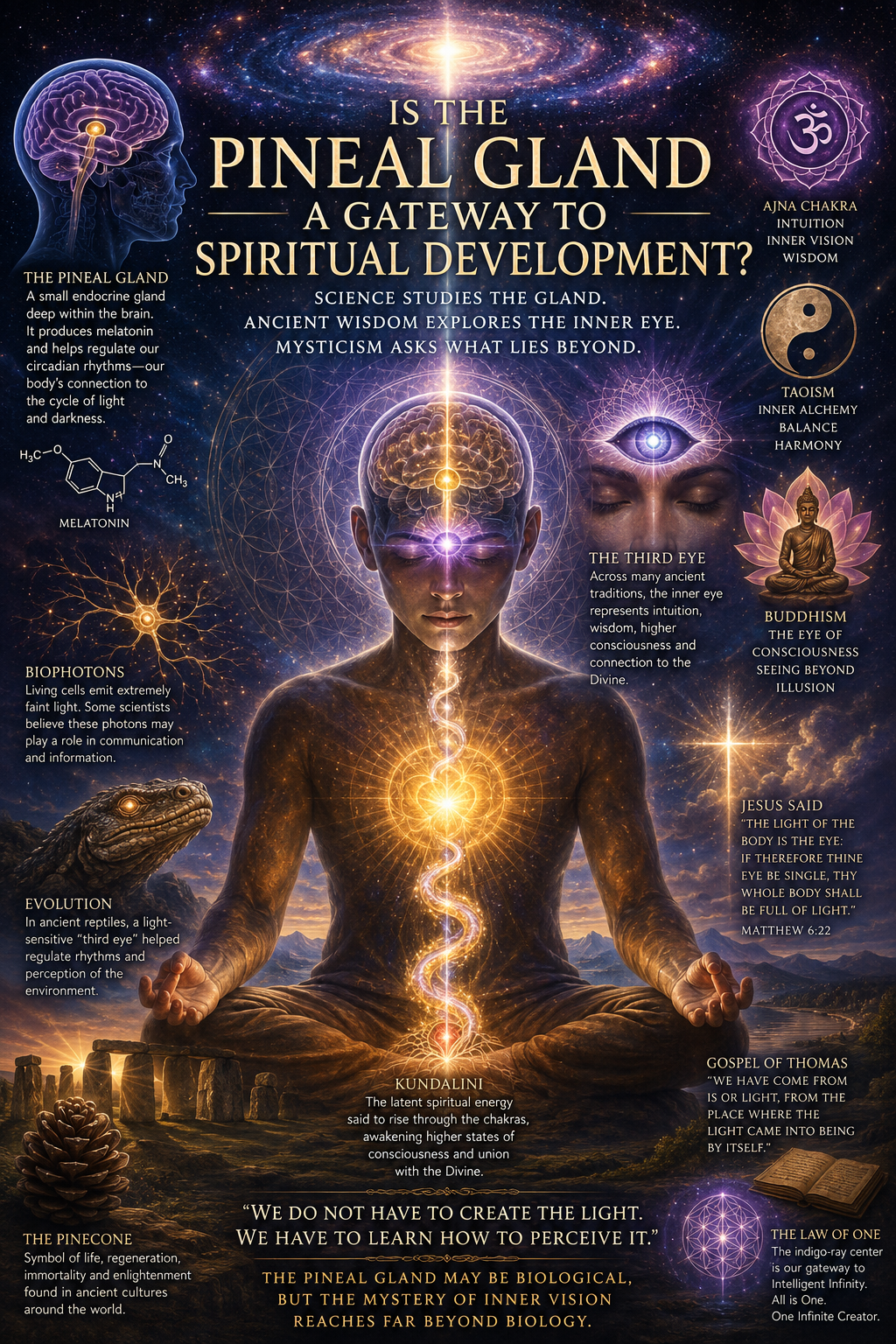
Near the center of the human brain lies a tiny, pinecone-shaped organ called the pineal gland.
Modern science recognizes the pineal gland primarily for regulating our circadian rhythms and producing melatonin. Yet across spiritual and mystical traditions, humanity has also spoken for thousands of years about an inner eye, a center of illumination, spiritual vision, intuition, and higher consciousness. Dr Joe Dispenza explains:
Hindu traditions speak of the Ajna chakra, or third eye.
Taoist traditions describe inner centers cultivated through meditation and contemplation.
Buddhism speaks metaphorically of awakening and seeing beyond illusion.
Jesus used the imagery of the “single eye” and a body “full of light.”
Mystics throughout history have described inner illumination.
René Descartes famously speculated that the pineal gland was intimately connected with the soul.
And in The Law of One, the indigo-ray energy center is associated with spiritual transformation and the gateway toward Intelligent Infinity.
Are all these traditions describing the same thing?
We should be careful before saying they are.
Ancient spiritual teachers were generally not describing the pineal gland in the anatomical language of modern neuroscience. Yet when we place science, ancient wisdom, mystical experience, and metaphysics beside one another, an extraordinary question emerges:
Could the physical pineal gland somehow participate in a much larger process of human consciousness and spiritual development?
To explore that question, we must first understand what science actually knows.
The Pineal Gland According to Science
The pineal gland is a small endocrine gland located deep within the brain as part of a region known as the epithalamus.
Its best-established function is the production and secretion of melatonin.
Melatonin helps regulate our circadian rhythms—the approximately 24-hour biological cycles that coordinate many processes throughout the body.
These rhythms influence:
- sleep and wakefulness
- hormone secretion
- body temperature
- metabolism
- glucose regulation
- cardiovascular function
- immune activity
- alertness and cognitive performance
The pineal gland therefore participates in something fundamental to life:
Our biological relationship with light and darkness.
Light entering our eyes is detected by specialized cells in the retina.
That information travels to a region of the brain called the suprachiasmatic nucleus, which functions as the body’s master circadian clock.
From there, signals eventually influence the pineal gland.
During daylight, melatonin production is generally suppressed.
As darkness arrives, melatonin production increases.
So there is a remarkable biological pathway:
Light → Eyes → Brain → Pineal Gland → Melatonin → Biological Rhythm
The rotation of the Earth determines the cycle of day and night.
That cycle enters our biological system through light.
Our nervous system interprets it.
The pineal gland helps translate it into chemistry.
In a very real scientific sense, cosmic and planetary rhythms become biological rhythms within us.
That alone should inspire wonder.
An Ancient Relationship With Light
The evolutionary history of pineal-associated structures makes this story even more interesting.
In certain reptiles and other vertebrates, structures associated with the pineal complex can be directly sensitive to light. Some species possess a structure sometimes called a parietal eye, or popularly a “third eye.”
It does not function like the two primary eyes used for ordinary vision, but it can participate in detecting environmental light and regulating biological rhythms.
Humans do not possess a functioning third eye of this kind.
Nevertheless, there is an authentic evolutionary relationship between pineal-associated biology and the detection of light.
That does not prove that the human pineal gland provides psychic or spiritual vision.
But it creates an intriguing biological backdrop for one of humanity’s most persistent spiritual metaphors:
the inner eye.
The Pinecone: A Symbol Across Cultures
The pineal gland received its name because its shape resembles a pinecone.
Pinecones themselves have appeared symbolically in several ancient cultures.
Because evergreen trees remain green through winter and their cones contain seeds capable of generating new life, pinecones have been associated with ideas such as:
life,
fertility,
regeneration,
renewal,
and immortality.
Modern esoteric teachings frequently interpret ancient pinecone imagery as evidence that ancient civilizations understood the pineal gland and its spiritual significance.
That possibility is fascinating, but historical caution is necessary.
We cannot confidently claim that every ancient pinecone symbol represented the anatomical pineal gland.
The symbolism may instead have represented fertility, regeneration, eternal life, divine power, or other concepts depending upon the culture.
Yet the parallel remains thought-provoking.
The pinecone symbolizes potential life.
The pineal gland responds indirectly to light and darkness.
And mystical traditions repeatedly describe spiritual awakening as moving:
from darkness into light.
Perhaps the most important connection is not anatomical.
Perhaps it is symbolic.
Biophotons: Is There Really Light Within Us?
Modern science has discovered something that sounds almost mystical:
Living organisms emit extremely faint light.
These emissions are sometimes called biophotons, or more precisely, ultraweak photon emissions.
They are associated with biochemical reactions, particularly oxidative metabolic processes occurring within living cells.
Researchers have detected ultraweak photon emissions from many biological tissues, including nervous tissue.
This is established science.
However, we need to distinguish this discovery from more speculative claims.
Some researchers have proposed that biophotons might participate in biological signaling or information processing. More speculative theories have asked whether they could somehow contribute to neural communication or even consciousness.
Science has not established that neurons primarily communicate through biophotons, nor has it demonstrated that biophotons connect human consciousness with nonphysical or interdimensional realities.
Those ideas remain hypotheses.
Nevertheless, the fact that living biological systems literally produce extremely faint photons is fascinating when considered alongside ancient spiritual teachings about inner light.
The Gospel of Thomas contains a remarkable saying attributed to Jesus:
“We have come from the light, from the place where the light came into being by itself.”
The ancient writer obviously was not describing modern photon physics.
Yet the symbolism is profound.
Across cultures, light has repeatedly represented consciousness, wisdom, divinity, awakening, knowledge, and our connection with the Source of existence.
Perhaps ancient teachers were not describing physical photons.
Perhaps they were describing an experience.
An experience of illumination from within.
The Third Eye in Hindu and Yogic Traditions
One of the clearest spiritual parallels is found in Hindu and yogic traditions.
The Ajna chakra, commonly known as the third-eye chakra, is traditionally associated with the region between the eyebrows.
It represents qualities such as:
intuition,
discernment,
inner vision,
wisdom,
spiritual perception,
and expanded awareness.
In Kundalini traditions, spiritual energy is described as moving upward through a series of energy centers or chakras.
Each center represents different aspects of human consciousness and experience.
As consciousness becomes increasingly balanced and refined, Kundalini is described as ascending toward the higher centers.
Ajna represents a profound transition.
Ordinary perception begins giving way to inner perception.
Modern spiritual teachings frequently associate Ajna directly with the pineal gland.
Classical yogic traditions, however, were describing a subtle spiritual anatomy, not necessarily an anatomical endocrine gland in the modern scientific sense.
Perhaps the two should not be forced into being identical.
They may instead represent different levels of description.
One describes biology.
The other describes consciousness.
Whether the two interact remains an open question.
Kundalini and the Pineal Gland
Kundalini awakening is described in yogic traditions as the activation or ascent of a latent spiritual energy through the body’s subtle-energy system.
People who report profound Kundalini or mystical experiences sometimes describe:
inner light,
energy moving through the spine,
pressure or sensation in the forehead or crown,
heightened intuition,
vivid dreams,
synchronicities,
altered perception,
expanded awareness,
profound love,
bliss,
unity,
and a sense of connection with something infinitely greater than the individual self.
Science has not established that the pineal gland causes Kundalini awakening.
Therefore, it would be inaccurate to say that simply “activating the pineal gland” awakens Kundalini.
From a broader metaphysical perspective, however, perhaps the pineal region, nervous system, brain, energy centers, and consciousness participate together in experiences that ancient traditions described through the language of Kundalini.
The physical body and spiritual consciousness may not need to be competing explanations.
Perhaps they are different aspects of the same human experience.
Taoism and the Inner Center
Taoist traditions developed sophisticated practices of meditation, breath, internal awareness, and energetic cultivation.
Certain Taoist systems describe inner energetic centers in the head and practices involving focused awareness, stillness, and contemplation.
Modern interpretations sometimes associate these centers with the pineal and pituitary regions.
We should again be historically careful.
Ancient Taoists were not necessarily describing the anatomical pineal gland.
Their system was primarily experiential.
Through meditation, stillness, breathing, and internal cultivation, practitioners sought to refine awareness and return toward harmony with the Tao—the underlying Way or principle of existence.
The deeper parallel may therefore be simple:
When attention stops constantly moving outward, consciousness begins moving inward.
The physical eyes become less important.
Another kind of seeing begins.
Buddhism: Seeing Beyond Appearance
Buddhism generally does not assign the pineal gland a special role in enlightenment.
Instead, Buddhism focuses directly upon consciousness.
Through meditation and disciplined observation, practitioners examine:
thoughts,
emotions,
desires,
attachments,
suffering,
impermanence,
the nature of self,
and awareness itself.
In Buddhism, awakening means learning to perceive reality without the distortions created by attachment, ignorance, and conditioning.
The physical eyes see the world of appearances.
The awakened consciousness sees more deeply into the nature of experience itself.
This gives us another version of the ancient idea of an inner eye.
Perhaps the third eye does not simply mean seeing invisible objects.
Perhaps it means:
seeing clearly.
Jesus and the “Single Eye”
One of the most intriguing biblical passages concerning spiritual vision appears in Matthew 6:22:
“The light of the body is the eye: if therefore thine eye be single, thy whole body shall be full of light.”
Some modern metaphysical interpretations identify the “single eye” with the third eye or pineal gland.
Historically, however, there is no strong evidence that Jesus was specifically teaching the anatomical activation of the pineal gland.
Within the context of the passage, the teaching can be understood as referring to spiritual clarity, purity of intention, and the inner orientation of a person’s consciousness.
Yet the symbolism deserves attention.
Jesus repeatedly used imagery involving:
light,
darkness,
seeing,
blindness,
awakening,
and inner transformation.
Perhaps “seeing” in these teachings means more than physical sight.
A person can have perfect physical eyesight and remain spiritually blind.
Another person may perceive something profound that cannot be seen with physical eyes.
That is the essence of inner vision.
“The Kingdom Is Within You”
Jesus also taught that the Kingdom of God is not simply something to be found externally.
Luke 17:21 has traditionally been translated:
“The kingdom of God is within you.”
Some modern translations render the phrase as “among you” or “in your midst,” and scholars debate the precise meaning.
Nevertheless, mystical Christianity has long emphasized the inward journey.
The Divine is not necessarily discovered only through institutions, buildings, rituals, or external authorities.
The journey also takes place within consciousness.
This parallels many contemplative traditions.
Meditation.
Prayer.
Silence.
Self-examination.
Contemplation.
All turn awareness inward.
Perhaps the deepest spiritual discoveries begin when we stop searching exclusively outside ourselves.
Jacob, Peniel, and “Seeing God”
Genesis 32:30 tells us:
“So Jacob called the name of the place Peniel: for I have seen God face to face, and my life is preserved.”
The similarity between Peniel and pineal has led some modern spiritual writers to propose that the biblical passage secretly refers to the pineal gland.
Linguistically, however, the words have different origins.
Peniel or Penuel comes from Hebrew and means approximately “face of God.”
Pineal comes from Latin pinea, referring to a pinecone.
Therefore, the similarity of the words does not demonstrate that Genesis was referring anatomically to the pineal gland.
Yet the story remains symbolically powerful.
Jacob undergoes struggle.
He is transformed.
Then he declares:
“I have seen God face to face.”
Again we encounter the ancient relationship between:
transformation and seeing.
Perhaps humanity’s repeated references to an inner eye are ultimately about transformation of perception.
René Descartes and the “Seat of the Soul”
Centuries later, the philosopher René Descartes became fascinated with the pineal gland.
Descartes believed the pineal gland played a unique role in connecting the immaterial mind with the physical body.
He famously associated it with what became known as the “seat of the soul.”
Modern neuroscience does not support Descartes’ anatomical theory.
But the philosophical question he raised remains unresolved:
How does subjective consciousness relate to the physical brain?
We can map neural activity.
We can measure electrical impulses.
We can observe neurotransmitters.
We can image the brain while someone meditates, dreams, remembers, loves, fears, or prays.
But there remains a profound mystery.
Why is any of this accompanied by subjective experience?
Why does consciousness exist at all?
This is sometimes called the hard problem of consciousness.
And science has not solved it.
Does the Pineal Gland Produce DMT?
Another popular theory proposes that the pineal gland produces the psychedelic molecule DMT—dimethyltryptamine.
DMT occurs naturally in mammals, and research indicates that mammalian tissues possess biological mechanisms capable of synthesizing it.
Animal research has also detected DMT within the brain.
This has led to theories that large quantities of DMT might be released from the pineal gland during:
dreams,
birth,
mystical experiences,
near-death experiences,
or death.
These ideas are fascinating.
But they have not been established scientifically in humans.
There is currently no convincing evidence demonstrating that the human pineal gland releases a massive DMT surge responsible for dreams, near-death experiences, astral projection, or spiritual awakening.
That does not mean future research could not reveal new information.
It simply means we should distinguish:
what is known
from
what is possible.
Pineal Calcification and the “Third Eye”
The pineal gland commonly accumulates calcium deposits as people age.
This is known as pineal calcification.
Some research has explored whether greater calcification might be associated with changes in melatonin production or circadian function.
However, popular claims often go much further.
We frequently hear that fluoride “closes the third eye” or that special detoxification protocols can “decalcify the pineal gland” and produce psychic abilities.
Science has not established those claims.
Supporting normal pineal and circadian function is much more straightforward.
Healthy practices include:
regular exposure to natural daylight, particularly in the morning,
maintaining consistent sleep patterns,
reducing excessive bright light at night,
regular physical activity,
supporting metabolic and cardiovascular health,
and allowing the body to experience a healthy distinction between daylight and darkness.
Interestingly, these simple practices reconnect us with something our ancestors experienced naturally:
the rhythm of nature.
Meditation and the Inner Eye
Meditation may be one of the most important bridges between ancient spiritual practice and modern consciousness research.
During meditation, outward sensory attention may gradually decrease.
Thoughts may become quieter.
Breathing may slow.
The autonomic nervous system may shift.
The sense of the physical body may change.
Brain-wave patterns may change.
And consciousness may enter states that differ significantly from ordinary waking awareness.
Some meditators report seeing:
points of light,
fields of brightness,
colors,
geometric patterns,
tunnels,
or luminous imagery.
Science may interpret some of these phenomena through visual processing, retinal activity, neurological changes, attention, or altered brain states.
Mystical traditions may interpret them as perceptions of subtle energy or spiritual light.
Perhaps we do not always need to force one explanation to destroy the other.
One asks:
What is happening biologically?
The other asks:
What does the experience mean?
Those are different questions.
The Law of One and the Indigo-Ray Energy Center
The Law of One provides another framework for understanding the third eye.
According to Ra, the human being is not merely a physical body.
We are a mind/body/spirit complex.
Consciousness operates through a system of energy centers corresponding broadly with the chakra system.
The sixth energy center is the indigo-ray center.
Within this metaphysical framework, the indigo ray is associated with deep inner work, spiritual awareness, intelligent energy, and the gateway toward Intelligent Infinity.
But there is an important lesson here.
Spiritual awakening is not achieved simply by trying to force open the sixth chakra.
Energy must move through the entire system.
Our fears matter.
Our relationships matter.
Our anger matters.
Our grief matters.
Our sexuality matters.
Our ability to communicate truth matters.
Our ability to love ourselves and others matters.
Everything is connected.
The lower energy centers cannot simply be ignored while we attempt to reach higher consciousness.
This may explain why genuine spiritual development often involves confronting our shadow—the parts of ourselves we have rejected, suppressed, feared, or refused to understand.
Healing becomes part of awakening.
Forgiveness becomes part of awakening.
Self-knowledge becomes part of awakening.
Love becomes part of awakening.
Our Pineal Gland Is Already Active
People often speak about “activating the pineal gland.”
But biologically, the pineal gland is already active.
It is participating in circadian regulation and melatonin production throughout our lives.
Perhaps the more meaningful spiritual question is not:
“How do I activate my pineal gland?”
Perhaps it is:
“How do I awaken my consciousness?”
From a metaphysical perspective, what people call third-eye activation may represent increasing:
intuition,
discernment,
inner awareness,
symbolic perception,
sensitivity,
clarity,
dream awareness,
and connection with something greater than the individual ego.
Most of us may already experience these qualities to some degree.
Sometimes we simply know something without immediately understanding why.
Sometimes a dream reveals what our waking consciousness has ignored.
Sometimes meditation produces an insight that changes our life.
Sometimes synchronicities appear at meaningful moments.
Sometimes intuition seems to speak quietly beneath the noise of thought.
The question is whether these experiences are generated entirely by unconscious neural processing or whether consciousness may extend beyond our current understanding of the brain.
Science has not settled that question.
Does the Brain Create Consciousness?
This may ultimately be the deeper question behind the pineal gland.
The dominant neuroscientific model associates consciousness closely with brain function.
Change the brain and consciousness changes.
Damage certain brain regions and perception, memory, personality, or awareness may change.
That relationship is undeniable.
But correlation does not by itself completely resolve the philosophical question of whether the brain creates consciousness or serves in some way as a filter, receiver, or interface for consciousness.
Consider a radio.
Damage the radio and the music becomes distorted.
Destroy the radio and the music disappears from that particular device.
But that does not mean the radio created the broadcast.
This analogy does not prove that the brain works like a radio.
It simply illustrates another philosophical possibility.
What if consciousness is more fundamental than matter?
What if the brain does not create consciousness from nothing?
What if the brain organizes, limits, filters, and expresses a deeper field of consciousness?
This possibility brings us directly to the Law of One.
Infinite Intelligence and the One Infinite Creator
The Law of One begins from a radically simple idea:
All is One.
Everything that exists arises within one Infinite Reality—the One Infinite Creator.
From this perspective, consciousness is not an accidental byproduct appearing late in an otherwise unconscious universe.
Consciousness is fundamental to existence itself.
The stars.
The planets.
Life.
Matter.
Energy.
Mind.
Spirit.
All arise within Infinite Intelligence.
If this perspective is correct, then the human brain does not create consciousness in isolation.
The brain and body become instruments through which a greater consciousness experiences creation.
The pineal gland, therefore, would not need to be a magical organ containing the soul.
Instead, it could be one biological component within a vastly more complex mind/body/spirit system.
The third eye may represent the point at which our ordinary perception begins expanding beyond the limitations imposed by conditioning, fear, ego, and the illusion of separation.
The Pineal Gland as a Bridge
Perhaps we should stop asking whether the pineal gland is either biological or spiritual.
It is unquestionably biological.
Whether it also participates in spiritual states of consciousness remains an open question.
But perhaps the physical and spiritual descriptions operate at different levels.
Science describes:
mechanisms.
Spiritual traditions describe:
experience and meaning.
Metaphysics asks:
what ultimately exists beneath both?
The pineal gland regulates our relationship with physical light.
The third eye symbolizes our relationship with inner light.
Science studies the first.
Mysticism explores the second.
Perhaps consciousness somehow connects them.
From Darkness Into Light
Throughout human history, spiritual awakening has repeatedly been described through the language of light.
Illumination.
Enlightenment.
Awakening.
Seeing.
Vision.
Radiance.
The light within.
Why?
Perhaps because spiritual development is fundamentally a transformation in how we perceive reality.
At first, we see ourselves as separate.
Separate from one another.
Separate from nature.
Separate from God.
Separate from the universe.
But as consciousness expands, those boundaries may begin to soften.
We begin recognizing interconnectedness.
Our actions affect others.
Our thoughts affect our emotions.
Our emotions affect our bodies.
Humanity affects the Earth.
The Earth exists within a solar system.
The solar system exists within a galaxy.
The galaxy exists within an incomprehensibly vast universe.
And everything emerged from the same underlying reality.
Perhaps spiritual awakening is ultimately the realization that:
we were never truly separate.
So, Is Our Pineal Gland for Spiritual Development?
Science can confidently say that the pineal gland plays an important biological role in circadian rhythms and melatonin production.
Science cannot currently demonstrate that the pineal gland is literally a gateway to other dimensions, the seat of the soul, or an organ of psychic perception.
Ancient traditions generally did not anatomically identify the pineal gland in the way modern esoteric teachings sometimes claim.
Yet those same traditions repeatedly discovered something extraordinary through meditation, contemplation, prayer, self-inquiry, and spiritual practice:
Human consciousness can change.
It can expand.
It can become more compassionate.
More intuitive.
More aware.
More peaceful.
More connected.
More capable of perceiving beyond the narrow boundaries of the ego.
Perhaps the greatest mistake would be reducing the third eye to a tiny gland.
The pineal gland may be part of the biological story.
But spiritual awakening involves the whole being.
Body.
Mind.
Emotions.
Heart.
Consciousness.
Spirit.
From the perspective of the Law of One, we do not reach Infinite Intelligence merely by activating a particular organ.
We gradually remove the distortions that prevent us from recognizing what has always been present.
We balance fear with understanding.
Anger with acceptance.
Separation with compassion.
Ignorance with awareness.
And self with other-self.
Perhaps this is what it means for the single eye to become full of light.
The physical eyes show us the world outside ourselves.
The inner eye allows us to see within.
And as that inner vision becomes clearer, perhaps we begin to recognize the deepest truth taught by mystics across the ages:
The light we have been searching for was never somewhere far away.
The Infinite Intelligence behind creation is present throughout creation.
Within every atom.
Within every living being.
Within consciousness itself.
We do not have to create the light. In
We have to learn how to perceive it.
And perhaps that is the true meaning of awakening the third eye.

Leave a Reply