Mystics throughout history have understood this not merely as a future heaven, but as an awakened state of being — a radical transformation of consciousness. In this view, the “kingdom” is realized when the fragmented, conditioned self becomes aligned with the deeper divine awareness within.Modern neuroscience adds compelling layers to this ancient wisdom. The heart generates the body’s most powerful electromagnetic field — roughly 60 times stronger electrically and up to 5,000 times stronger magnetically than the brain’s — and this field can be measured several feet away. Emotions profoundly shape the nervous system, hormonal balance, perception, and behavior. Thoughts, through neuroplasticity, literally reshape neural pathways and influence how we interpret reality. When people live in chronic fear, they perceive more danger and limitation. When they cultivate gratitude, purpose, and love, they more readily notice opportunity, connection, and meaning. Psychology describes this as cognitive filtering, attentional bias, and expectancy effects. Spirituality often calls it vibration, alignment, or consciousness.The crucial distinction is this: our inner state powerfully influences how we experience and respond to reality, but it does not mean we individually control all external events through thought alone.
and
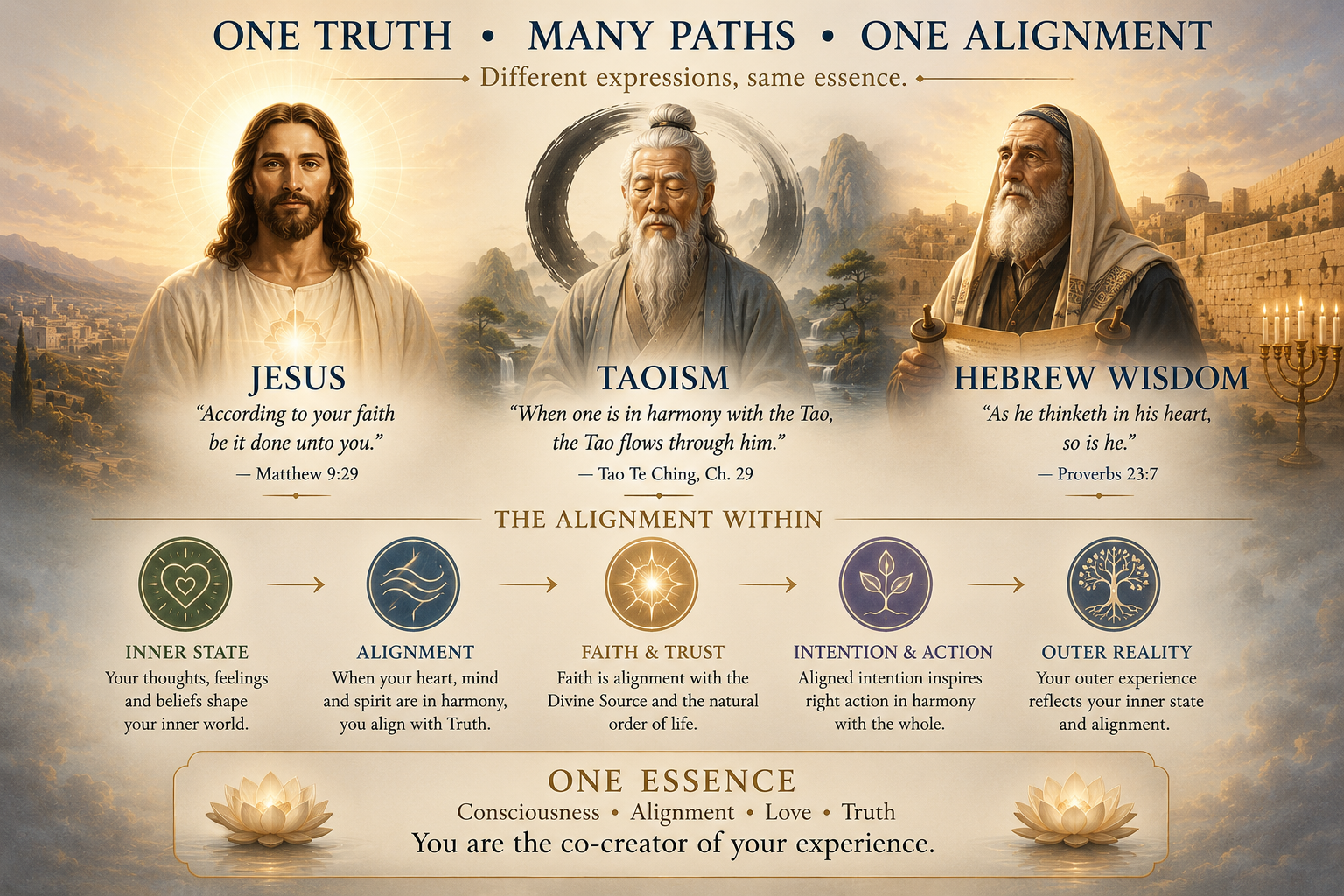
Esoterically, the “single eye” has long been interpreted as unified consciousness — awareness no longer fragmented by fear, duality, and illusion.Many of the world’s mystical systems point toward the same realization: awareness behind thought, presence beyond identity, love over fear, conscious living instead of unconscious reaction, and alignment with what various traditions call God, Source, Tao, Spirit, or the Infinite Creator.The teaching “According to your faith be it done unto you” is widely understood as pointing to the profound influence of consciousness, belief, and inner alignment on human experience. In the context of Jesus’ teachings, faith was far more than positive thinking. It meant deep inner alignment with the divine, trust in the Infinite, openness to transformation, and living from love rather than fear. The principle is that our inner condition influences how we perceive reality, what possibilities we recognize, the actions we take, the energy we bring into relationships, and how we ultimately respond to life.Modern psychology strongly supports key aspects of this. Deeply held beliefs shape perception, expectation, emotional states, and behavior. People often unconsciously recreate repeating life patterns because they carry the same inner programming. When those beliefs transform at a core level, behavior and life direction frequently change as well.Mystically, the traditions converge on these dynamics:
- Fear creates contraction
- Faith creates openness
- Love creates coherence
- Awareness creates freedom
Thus, the “reality creation” spoken of is less about controlling the universe like a magician and more about participating consciously in life rather than reacting unconsciously from conditioning.This wisdom appears across traditions:
- Hebrew Bible / Proverbs: “As a man thinketh in his heart, so is he” (Proverbs 23:7) and “Above all else, guard your heart, for everything you do flows from it” (Proverbs 4:23). In Kabbalah, the lower world reflects the upper world, and human beings, made in the divine image, participate in creation through thought, word, intention, and action.
- Taoism: Reality flows from the unseen Tao. The wise person does not force outcomes through ego but aligns with the Tao through stillness, humility, simplicity, and wu wei (non-forcing action).
“When one is in harmony with the Tao, the Tao flows through him.”
“Knowing others is wisdom; knowing yourself is enlightenment.” (Tao Te Ching, Ch. 33)
“The Master sees things as they are, without trying to control them.” (paraphrased from Ch. 29) - Gospel of Thomas and contemplative Christianity: Emphasis on inner awakening, gnosis (self-knowledge), and realizing the divine light already present within.
Together, these teachings reveal a shared mystery: when the inner world transforms, the outer life begins to transform. The transformation always begins within.Practices such as meditation, contemplative prayer, breathwork, and stillness allow us to observe the mind instead of being ruled by it. In that sacred space, many discover they are not merely their personality, their fears, or their programming — but the pure awareness that witnesses it all. That realization can radically change how a person lives, loves, responds, and creates meaning in the world.
Leave a Reply